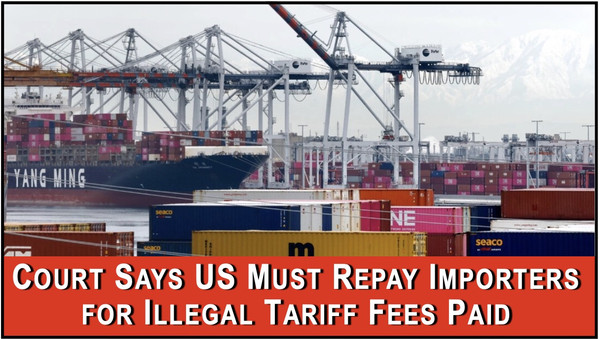
Judge Rules Importers Are Entitled to Tariff Refunds
The U.S. Court of International Trade’s decision follows the Supreme Court’s ruling last month that struck down most of the president’s levies.by Kimberly Hayek, The Epoch Times.com, March 4, 2026
A federal judge ruled Wednesday that companies are owed refunds for tariffs imposed by President Donald Trump that were later overturned by the Supreme Court.
The U.S. Court of International Trade handed down the ruling in a case filed by Atmus Filtration Inc. It applies to all importers of record for goods subject to the duties, which were implemented via executive orders under the International Emergency Economic Powers Act (IEEPA).
The ruling comes after the Supreme Court’s Feb. 20 landmark 6-3 decision in Learning Resources Inc. v. Trump, finding the tariffs were unconstitutional because the president did not have the authority to levy them under IEEPA.The high court underscored the trade court’s exclusive jurisdiction over such claims, highlighting that importers could seek relief there in a footnote.
Click Here to Watch/Listen to the Newest We the People Convention Weekly News & Opinion Podcast!Atmus Filtration sought refunds of all funds paid under the executive orders, as well as interest.
The trade court cited the U.S. Constitution’s requirement for uniform duties and the Customs Courts Act of 1980, which created the court to ensure consistent rulings in import disputes. The chief judge assigned a single presiding judge for all IEEPA duty refund cases to avoid inconsistencies.
“To find otherwise would be to thwart the efficient administration of justice and to deny those importers who have filed suit the efficient resolution of their claims, and to deny entirely importers who have not filed suit the benefit of the Learning Resources decision,” the court wrote.
Trump deployed the IEEPA to impose reciprocal rates on dozens of countries and additional levies on Mexico, Canada, and China related to drug trafficking.
Firms such as Learning Resources, an Illinois-based toy maker, challenged the measures, arguing they threatened business survival.The Penn Wharton Budget Model estimated the Supreme Court’s decision could lead to $175 billion in tariff refunds. Trump has suggested that refunds will need to be litigated in courts.
FedEx filed a related lawsuit on Feb. 23. It sought full refunds plus interest and attorney’s fees, citing the Supreme Court ruling. The company is among several pursuing claims post-ruling.
On March 2, the U.S. Court of Appeals for the Federal Circuit rejected the Trump administration’s efforts to delay refunds, remanding cases to the trade court without explanation.
U.S. Trade Representative Jamieson Greer announced on Feb. 20 that his office will launch investigations under Section 301 of the Trade Act.
Senate Democrats introduced a bill Feb. 23 to require refunds within 180 days, with interest and regular updates to Congress. Sponsored by Sens. Ron Wyden (D-Ore.), Edward Markey (D-Mass.), and Jeanne Shaheen (D-N.H.), the measure seeks to expedite relief for affected importers.
