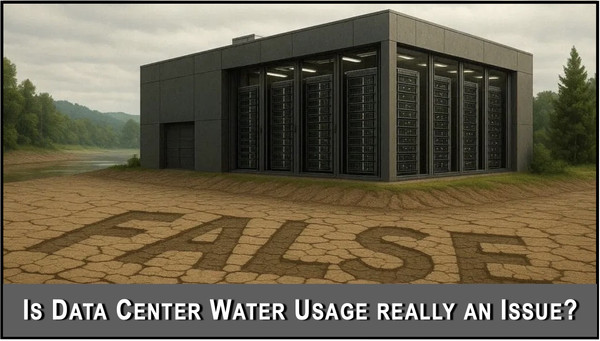
Grassroots Revolt or Manufactured Panic? The War on Data Centers . . .
How Water Panic Became the New Tool to Block American Innovation
by Amuse on X, January 25, 2026
The modern fight over data centers is often presented as a simple clash between a company and a town. The company wants to build, the town wants answers, and a few bad meetings produce a familiar story about distrust. That picture is incomplete. What is happening across the country is more organized than we are being told, more strategic than most local voters realize, and more politically sophisticated than the usual nimby label can capture. The opposition has learned how to scale. It does so by taking an issue that is genuinely intimate, water, and turning it into a veto on American infrastructure.
The key move is to frame the project not as industrial development but as an existential threat to the basics of life. People will debate taxes and jobs. They will fight about aesthetics. They will tolerate noise. They do not gamble with drinking water. No one, Democrat or Republican, wants a facility that will drain wells, drop the water table, or price families out of their own utilities. If you can persuade a community that a data center means their tap runs dry, you do not need to win any other argument. You have already won.
This is why the water narrative sits at the center of the modern anti data center campaign. It is not an accident that the same themes repeat from Virginia to Arizona to Indiana. We hear the same numbers, the same rhetorical templates, and the same emotional images of dry ponds and anxious homeowners. We hear the same insinuation that the company is hiding the truth, that officials are captured, and that the only honest actors are the activists. The story is designed to travel.
A puzzled reader might ask, is this not simply what democracy looks like, citizens objecting to development. Sometimes it is. A town has every right to negotiate for protections, to demand transparency, and to insist on responsible siting. The question is not whether citizens may object. The question is whether a concerted and organized network is manufacturing fear and then laundering it through local meetings in order to stop buildouts community by community. On that question, we should be more alert.
READ ONE LOCAL EXAMPLE: Claims of data center water use are laughably wrong
Consider the politics of the coalition. The opposition is not confined to progressive climate groups, nor is it small. It consists of a loose but coordinated alliance of more than 200 NGOs, spanning environmental organizations, advocacy networks, explicitly anti capitalist and anti growth movements, and openly pro Marxist groups including the Democratic Socialists of America, Rise and Resist, People Power United, Earth Ethics, Greenpeace, Citizens Action Coalition, the Green Party, Extinction Rebellion, and many others operating under different banners but advancing the same functional objective. What makes this coalition effective is not ideological purity but tactical flexibility.
It has been remarkably successful at recruiting well meaning conservatives. That should not surprise us once we see the mechanism. A conservative who distrusts corporate power, who hates crony deals, and who wants local control can be induced to oppose a data center if the issue is framed as a threat to scarce resources and family budgets. The argument does not need to mention climate, capitalism, or Karl Marx. It needs only to say, your kids will not have water, your bills will spike, and your officials are lying. Once that story takes hold, it travels easily across partisan lines.
READ: Trump unveils plan to shift power costs for AI data centers from Consumers to Big Tech
That bipartisan surface is precisely what makes the campaign effective. If a project is opposed only by left activists, many voters discount it as an ideological reflex. If the opposition contains a mix of Democrats and Republicans, it looks organic. It looks like common sense. It looks like the project must really be dangerous because everyone is worried. That appearance is a strategic asset.
Behind the appearance is a deeper ideological architecture. Many of the NGOs driving these fights are not innocent local good government clubs. They are often the same set of organizations that have pushed global warming propaganda as a lever to stop development in the West, particularly in the US. They oppose pipelines, power plants, transmission lines, mines, dams, housing, and water projects. Data centers are simply the newest target, and AI is the newest scare word. If you want to slow American growth, you do not need to defeat American firms in the market. You can raise the cost of building anything.
Compounding this dynamic is the reality that many of these organizations receive funding indirectly through international foundations, donor networks, and intermediaries tied to the Chinese Communist Party and to Russian interests. The money is rarely labeled, and often passes through layers designed to obscure its origin, but the strategic alignment is unmistakable. Weakening American industrial capacity, delaying infrastructure, and fracturing local consent all serve the interests of foreign adversaries who benefit when the US cannot build.
In that respect, the water panic strategy is not merely a civic misunderstanding. It is a method of industrial policy conducted through sabotage of permitting and local politics. And it aligns neatly with the interests of America’s strategic rivals. China and Russia have a vested interest in holding US innovation and dominance back. They do not need to out invent the US if they can help ensure the US cannot build. Funding streams into environmental NGOs are often opaque. The studies and reports circulated at the local level frequently come from institutions whose incentives point in one direction, toward restriction, toward moratoria, toward delay, toward the presumption that development is guilt.
One may object that foreign funding claims are hard to prove in any specific case. That is true as a matter of public documentation, and the claim here is not that every local activist is a foreign agent. The point is structural. If you build a national campaign to block infrastructure, you create an obvious channel that adversaries can exploit. You create a political machine that functions like an internal brake on American capacity. It would be strange if adversaries did not try to support it.
Nowhere is the water narrative, and the machinery behind it, clearer than in the fight over Amazon’s New Carlisle, Indiana data center campus. It is a massive project on roughly 1,200 acres of former farmland in St. Joseph County. Reports suggest it will eventually host on the order of 18 to 35 data halls and could demand as much as 2.2 gigawatts of electric power at full build out. The scale makes it an easy symbol. For doomer activists, size is an argument. They point to acreage and megawatts and then invite the listener to imagine a vampire machine attached to the county aquifer.
The claim is that the facility will use all of the county’s water, that it will drain drinking water supplies, and that it will raise costs. This is the claim that moves people. It is also the claim that collapses when we adopt a disciplined way of thinking.
Start with a simple principle. A water debate should begin with comparative magnitudes. Without comparison, the word millions becomes a spell. Millions of gallons sounds like a catastrophe until we ask, compared to what. The relevant comparators are not your kitchen sink. They are the other large scale users of water in the same region, agriculture, irrigation, manufacturing, and the energy sector that produces the electricity everyone uses.
On that comparative frame, the national picture is striking. All data centers in the US combined use only about 3% of the water that US golf courses use for irrigation in a year. That is not a moral argument about golf. It is a clarity argument about scale. We tolerate, and often celebrate, water intensive uses that produce far less strategic value than AI infrastructure, but we treat data centers as uniquely suspect.
We can sharpen the point locally. St. Joseph County has 10 golf courses. Each uses water. Each relies on irrigation. The basic claim in New Carlisle is that Amazon’s facility will consume so much water that residents will suffer. Yet a county already supports many water users without apocalyptic rhetoric. Why does the data center become the singular threat. Because it is new, because it is unfamiliar, and because the campaign has taught people to imagine AI as a thirsty monster.
Now add the specific facts about New Carlisle as they are asserted. The site was farmland. Farms use water. In many places, irrigation and agricultural drainage dominate local hydrology. If the data center uses less water than the farm it replaced, then the baseline story, the project is a net drain on local water, fails on its own terms. And that is the asserted situation here. Even before we discuss investments or caps, the shift from agricultural land use to modern industrial use can reduce certain forms of water demand.
A puzzled reader may ask, how could a giant data center use less water than a farm. The answer is that the water use profile of a modern hyperscale facility depends on cooling design, climate, and operational choices, not just on square footage. Many facilities use primarily air cooling and invoke evaporative water cooling only during the hottest conditions. Water use is often lumpy. It spikes on peak heat days. It can be near zero for long stretches.
That is the core claim Amazon has made about this facility. AWS has stated it expects to rely on air cooling and not to withdraw or use water for cooling more than about 2% of the year. If that is even roughly correct, then the local water impact is not a daily constant draw. It is a limited, intermittent use during the hottest days.
I was really surprised when I first saw this chart on water use by data centers. Given how much it gets discussed as a supposed problem I would have expected it to be more than this. pic.twitter.com/hjI8GSHLKD
— Timothy B. Lee (@binarybits) October 28, 2025
Notice what this does to the rhetoric. The activist line, it will use millions of gallons, is designed to sound like a daily drain. But if the draw occurs only on the hottest periods, then the meaningful question becomes, what is the annual total, what is the peak day volume, what is the cap, and what is the aquifer’s sustainable yield. That is a technical question. It is also a question that can be managed by policy.
St. Joseph County officials have not treated the aquifer as an open buffet. They have proactively imposed a strict cap on withdrawals. In a 2025 agreement among county and municipal entities, Amazon and a nearby GM and Samsung battery facility are limited to a combined 24 million gallons per day from the Kankakee River aquifer system. The point of the cap is protection. A cap is a hard boundary. It makes the doomer claim, they will use all our water, analytically irresponsible. They cannot legally do so.
Even more important is the relationship between the cap and the aquifer’s asserted safe yield. Hydrology is not guesswork. Aquifers recharge. They have sustainable yield estimates. The safe yield in this case has been cited around 44.5 million gallons per day. A 24 million gallons per day cap across 2 large facilities is about half the safe yield, leaving a substantial buffer. That does not mean there is zero risk. It means the governing structure is built around a conservative margin.
At this point, the reader may worry, but what if Amazon alone still uses a large share of the cap. This is where the asserted operational profile matters. Amazon is not expected to use 5% of the daily capacity. The project is not described as a 24 million gallon per day continuous user. The cap is a ceiling, not a forecast. And we have an additional comparison that anchors the imagination, the 10 golf courses and the prior farmland demand.
We should also distinguish between construction effects and operational effects. Much of the panic in Indiana has been fueled by stories of wells and ponds dropping during construction. That is serious for affected families. But it is not the same as the operational water draw of a completed facility. Large construction sites often involve dewatering, temporary pumping to keep soils workable for foundations and buried infrastructure. Drought can also stress shallow wells. If a local well fails during a dry summer while a mega project is moving earth, suspicion is natural. But suspicion is not a verdict.
In a properly governed environment, this is where monitoring and enforcement matter. Monitoring wells can track water tables. State agencies can investigate well failures. If a development is found to impair private wells, the law can require mitigation, alternate supplies, new wells, or reduced pumping. In other words, water use is not a handshake agreement. It is a regulated activity.
So far, the structure around New Carlisle reflects that reality. Authorities have set caps. They have imposed safeguards. They have installed monitoring. That is what serious governance looks like.
Now we can return to the core political argument. The doomer campaign does not merely raise technical questions. It asserts a narrative of predation, the company will drain you, and you are powerless. That narrative is useful because it short circuits bargaining. If people believe the project is a literal threat to life, they will not negotiate for improvements. They will demand abolition.
But a community that thinks clearly can do something better. It can treat a data center project as a negotiation over how to convert a large private investment into public benefit while maintaining strict protection of local resources.
In the New Carlisle case, the asserted facts already point toward that possibility. Amazon is not simply taking water. It is also investing in water infrastructure. Contributions of millions of dollars for upgrades can mean new wells, pumps, treatment capacity, and pipeline improvements that serve both the facility and residents. This matters because many local water systems face aging infrastructure and deferred maintenance. A large industrial customer can help fund modernization that residents would otherwise pay for through higher rates.
This is not a speculative idea. It is a known pattern in local infrastructure finance. When a large user anchors a system, utilities can spread fixed costs, upgrade equipment, and improve reliability. If managed well, the marginal effect can be lower per unit costs for residents, or at least smaller increases than would have occurred without investment. In Oregon, for instance, AWS partnered with local leaders to recycle data center cooling water for agricultural irrigation, sending up to 96% of the water back to local farmers at no charge. By doing so, the same gallon of water cools servers and irrigates crops, effectively multiplying its benefit rather than simply using it up. This kind of innovation is becoming more common, especially in water scarce regions. The question is not whether every project will deliver this benefit automatically. The question is whether local leaders will insist on it. They should.
Here is the deeper point that the doomer narrative tries to suppress. A well managed data center can increase the amount of water available to a community in effective terms. That sounds paradoxical because people think of water as a static pile. But capacity and quality depend on infrastructure. New wells, better treatment, improved distribution, and better monitoring can turn an abundant aquifer into a more reliable supply. It is a common pattern that large projects often fund utility upgrades that benefit everyone.
In The Dalles, Oregon, Google’s data center tax payments funded the majority of a new water treatment plant, saving local households from a 23% bill increase and instead limiting it to 7%. St. Joseph County is seeking a similar win win outcome. If Amazon helps pay to modernize the regional water system, residents could see improved water service and reliability as a direct result of the project’s presence, leaving the town with more robust water systems than it had before.
A reader might still worry, why take any risk at all, why not just say no. Because saying no is not neutral. It is a choice about national power and local prosperity. Data centers are not luxury projects. They are the physical substrate of modern computing, cloud services, defense systems, and the AI economy. If the US cannot build data centers, the US cannot lead in AI. And if the US does not lead, others will. In that sense, this is not merely a fight about zoning. It is a fight about whether America remains the engine of the world’s most consequential technological platform.
The doomer movement understands this. That is why it focuses on the most emotionally effective local lever, water fear. It wants to build a national outcome by winning a thousand small local battles. It knows it cannot argue openly for slowing American innovation. So it argues that your wells will run dry.
We should not let that story operate as an unexamined spell. We should insist on disciplined comparisons, hard caps, monitoring, and enforceable mitigation. We should insist that big firms pay for infrastructure improvements and that tax gains translate into public benefit. We should demand transparency, but we should also reject engineered panic.
There is also a message here for conservatives. Many conservatives have been shocked, with reason, at how easily grassroots voters can be pulled into these campaigns. The solution is not to sneer at citizens who are worried about their water. That worry is rational. The solution is to separate genuine resource stewardship from politically weaponized fear. A conservative should be able to say, our water comes first, our rights come first, and our community will enforce strict limits. And a conservative should also be able to say, America must build, and we will not outsource our future because activists learned how to frighten us.
If you want a quick test for whether a campaign is merely local concern or part of a scalable national strategy, ask what happens after the company offers hard caps, monitoring, and infrastructure investment. A purely local citizen movement might then shift into negotiation, what else can we secure for the town. A doomer network often does not. It treats safeguards as irrelevant because the real objective is not better water policy. The real objective is stopping the build.
The New Carlisle debate offers a chance to model a better approach. Begin with the comparative fact that data center water use is small relative to normalized uses like irrigation. Add the operational claim that this facility will use water for cooling only about 2% of the time. Add the political fact that officials have placed a strict withdrawal cap to protect the aquifer. Add the economic fact that the project can deliver major tax revenue and can fund water infrastructure upgrades that strengthen the community. Combine those elements and the moral picture changes. The data center is not a thief at the tap. It is a negotiable asset.
A final objection remains. What if a future drought is worse, what if demand rises, what if the cap is raised, what if officials fold. These are real questions, and they point to the correct remedy, institutional design. Make caps binding. Make monitoring public. Make mitigation automatic. Ensure residents have fast recourse for well failures. Tie incentives to compliance. A conservative politics of competence can do this.
But what we cannot do is allow the organized weaponization of water fear to become a standing veto on American infrastructure. The US did not become the world’s innovation leader by treating every new build as a moral scandal. It became a leader by building, by regulating responsibly, by upgrading infrastructure, and by refusing to let adversaries define the boundaries of what can be done.
Data center doomers have found a powerful rhetorical weapon. It works because it touches something sacred, the basic resources a family relies on. That is why the steelman response must be equally serious about water. Not by denying concerns, but by turning them into enforceable policy and into community benefit. If we do that, we can protect taps and wells, we can secure lower costs through better infrastructure, we can create major tax bases, and we can keep the US at the front of AI. If we fail, we will look back and realize that we surrendered strategic capacity not to a better competitor, but to a domestic network that learned how to frighten Americans with their own sink.
If you enjoy my work, please subscribe https://x.com/amuse/creator-subscriptions/subscribe.
