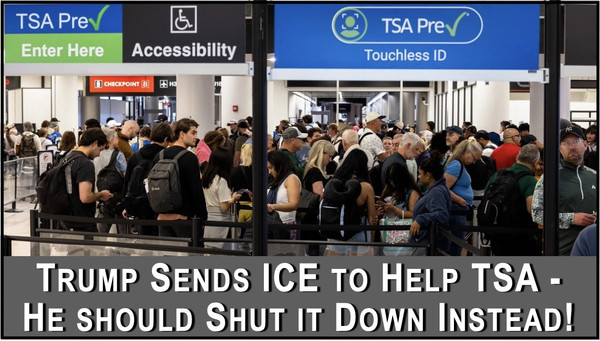
Trump Deploys ICE Agents to Airports to Assist TSA and freakout Democrats and Illegals . . . but it is not the long term answer we need!
by Alexander Muse, Amuse@X.com, March 23, 2026
President Donald Trump said on March 22 that he will deploy Immigration and Customs Enforcement (ICE) agents to airports on March 23 to help Transportation Security Administration (TSA) agents manage security checkpoints.
“On Monday, ICE will be going to airports to help our wonderful TSA Agents who have stayed on the job,” Trump wrote in a Truth Social post on March 22. “The great [White House border czar] Tom Homan is in charge!!!”
Trump said that he would send immigration agents to airports on March 21 after the Senate failed to advance a funding bill for the Department of Homeland Security, which has been in a partial shutdown since Feb. 13.The lapse of funding has caused people who work in agencies under the umbrella of the Department of Homeland Security, including TSA, Customs and Border Protection, ICE, and the Coast Guard, to work without pay.
“Radical Left Democrats, who are only focused on protecting hard line criminals who have entered our Country illegally, are endangering the USA by holding back the money that was long ago agreed to with signed and sealed contracts, and all,” Trump wrote.
Trump did not say which airports the ICE agents would be deployed to but said agents are “ready to go.” (Editor's Note: It will be interesting to see how the volume of air travelers drop because ICE agenst will be screening for Illegal Aliens!)
Chaos, Walkouts, and 95% Failure Rates: The Case Against the TSA Is Now Undeniable
Why the Democrat Funding Freeze Should Be the TSA's Last Act
|
In Dante’s Inferno, the eighth circle is reserved for fraud, and if Dante were sketching his map of Hell today, the Transportation Security Administration would deserve its own sub-basement. But the argument against the TSA has never been more viscerally obvious than it is right now, in the spring of 2026, as hundreds of agents walk off the job, four-hour security lines snake through America’s airports, and a charity that normally feeds war zones is delivering free meals to unpaid federal screeners at our nation’s terminals. We have arrived, at last, at the logical endpoint of a twenty-five-year experiment in bureaucratic security theater. The experiment has failed. The question is whether we have the political will to admit it.
Since February 14, the United States has been under a partial government shutdown affecting the Department of Homeland Security, leaving the TSA’s nearly 50,000 frontline officers required to screen passengers without pay. The Democrats’ refusal to fund DHS, absent unrelated concessions on immigration enforcement, has now stretched past 37 days. This is, importantly, not the first time. It is the third shutdown in less than six months that has forced the officers who screen airport passengers and luggage to keep working without pay. Each episode has compounded the damage. Each episode has revealed more starkly the fragility baked into this model. And each episode has made the same question more unavoidable: why are we doing this at all?
Callout rates have spiked nationwide, with the highest single-day airport callout rate reaching 55% at Houston Hobby International Airport on March 14, 2026. Attrition has also surged, with 366 TSOs leaving the force. More than 400 Transportation Security Administration workers have quit since the partial shutdown began, and of those who quit, almost half have over three years of experience, and a third have over five years. These are not transient workers looking for the door. These are trained, experienced professionals driven out by a bureaucratic arrangement that treats them as expendable political props. Eviction notices, vehicle repossessions, and empty refrigerators and overdrawn bank accounts are among the mounting financial strains TSA officers face. One charity normally deployed to disaster zones and active war areas is now feeding federal airport workers in American terminals. This is not a staffing problem. It is a structural indictment.
The suffering of individual TSA workers is real, and it is unjust. Workers who show up deserve to be paid. That principle is not in dispute. But the crisis has forced a reckoning that is larger than any individual paycheck. If a $10.5 billion federal agency cannot maintain basic operational continuity across a 37-day funding dispute, without food charities and billionaire offers to personally cover payroll, then it was never the robust security architecture its architects promised. It was always, at its core, a bureaucratic arrangement optimized for self-perpetuation, not performance.
Elon Musk offered to cover the salaries of TSA personnel during the ongoing government funding standoff, saying he would like to offer to pay the salaries of TSA personnel during this funding impasse that is negatively affecting the lives of so many Americans at airports throughout the country. The offer is generous. The fact that it was necessary is damning. When the private sector must rescue a federal monopoly from its own funding structure, the monopoly has made the argument for its own replacement. No private security contractor operating under competitive market conditions would find itself in this position. Private contractors are paid by contract, not appropriation. Their employees receive salaries regardless of congressional impasse. The structural vulnerability is not incidental to federal operation. It is intrinsic to it.
The TSA was founded on a promise. After the September 11 attacks, fear drove speed. Within weeks, Congress passed the Aviation and Transportation Security Act, federalizing what had been private screening. The rationale seemed obvious. Decentralization had failed, we were told. Only a uniform federal agency could prevent another catastrophe. But there was a problem embedded in that founding premise. The hijackers exploited not a failure of private screening uniformity but a failure of intelligence sharing and cockpit policy. They used boxcutters, not bombs. They boarded flights in airports where security met all then-existing standards. Federalizing screeners was a non-sequitur solution to a wholly different problem. That foundational error has now had twenty-five years to metastasize.
Consider the record on its own terms. In 2015, undercover investigators from the Department of Homeland Security smuggled weapons and explosives past TSA checkpoints in 67 out of 70 attempts, a 95% failure rate. If an airline or private contractor posted a number like that, they would be out of business, sued into dissolution, their leadership facing criminal inquiry. In government, it gets you a budget increase. Follow-up red-team tests conducted in 2017 still found failure rates exceeding 80%. As late as 2019, GAO reports documented ongoing systemic vulnerabilities in screening procedures. The only thing consistent about TSA performance across its entire institutional history is its consistent inadequacy.
Consider also the shoe removal requirement, that totemic ritual of post-9/11 bureaucratic irrationality, which the TSA only rescinded last summer after nearly twenty years. Richard Reid, the British national whose failed 2001 attempt to ignite shoe-embedded explosives inspired the policy, used non-metallic materials that existing screening would not have detected, then or now. The policy was imposed five years after the event. It was never adopted by any other major nation. Europe assessed the risk, found no justification, and moved on. We did not, because once a rule is inscribed in bureaucratic scripture, repealing it means admitting error, surrendering turf, and risking budget cuts. This is not a pathology. It is the operating logic of every federal agency ever created. The TSA is a particularly vivid specimen, nothing more.
The budget figures tell the same story. The TSA’s budget has grown from $6.8 billion in 2002 to more than $10.5 billion today, with this year’s request approaching $12 billion. A significant portion of this comes not from direct congressional appropriations but from the September 11 Security Fee levied on every airline ticket, a fee that has risen more than 300% since its creation. This is a stealth tax on mobility, collected in the name of security, spent largely on institutional overhead. Many passengers don’t really know who pays TSA officers, whether it is the federal government, airports or airlines, according to focus groups done by the US Travel Association. The opacity is not accidental. Bureaucracies obscure their costs precisely because visible costs invite scrutiny.
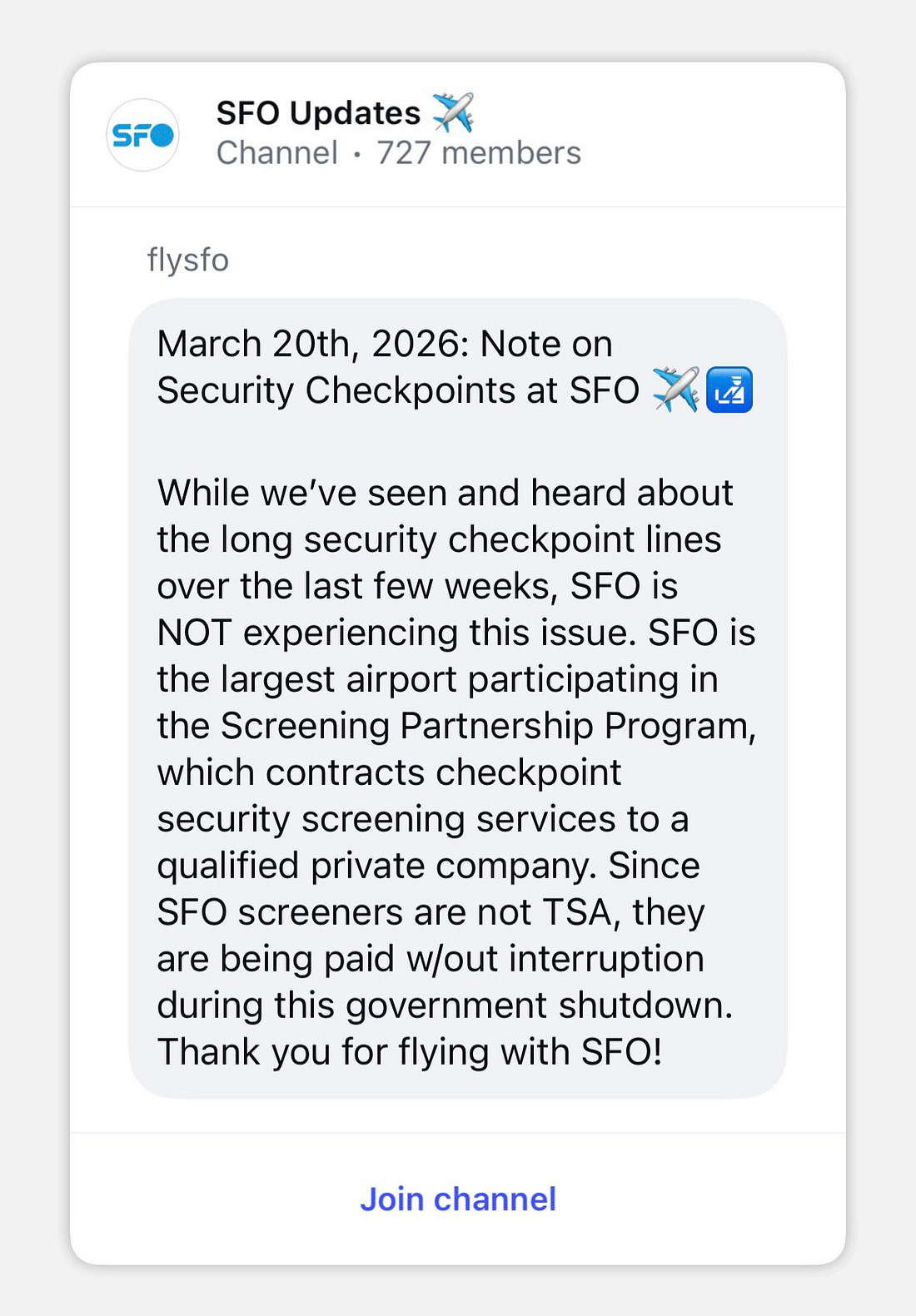 |
There is an alternative, and it already exists. The Screening Partnership Program, created as a concession to critics of federalization, allows airports, like SFO, to opt out of TSA screening in favor of private contractors. The catch is instructive: the TSA oversees the process. In other words, the agency whose monopoly is threatened gets to approve its own competition. Yet despite this structurally compromised arrangement, the program works. At San Francisco International Airport, private screeners process passengers more efficiently and with higher satisfaction scores than their TSA-managed counterparts. Kansas City and Bozeman show similar results. These are not anomalies. They are counterexamples that disprove the necessity of federal monopoly, which is precisely why the TSA has never been eager to expand the program.
Privatized screening under FAA regulatory oversight would preserve every legitimate public interest while restoring the accountability that federal monopoly has permanently extinguished. Airlines have every incentive to avoid security breaches. Unlike federal agencies, their failures carry real costs, reputational, financial, and legal. This dynamic fosters innovation and responsiveness that no bureaucracy can replicate, because no bureaucracy faces equivalent consequences for failure. Private screeners can be held to rigorous standards, assessed transparently, and replaced when they underperform. The same cannot be said of federal employees operating under union protections and political patronage networks that entrench mediocrity as a permanent condition.
Some will protest that security is too important to entrust to the private sector. This objection reverses the burden of proof. The public sector has had twenty-five years and approximately $200 billion to demonstrate its competence. The demonstration has been a failure by every measurable metric. There is no moral or empirical justification for maintaining a system that fails its own performance benchmarks while treating every passenger as a suspect, every shampoo bottle as a potential bomb, and every grandmother as a credible threat. The argument from importance, the idea that the stakes are too high for market accountability, is precisely backward. When the stakes are highest, accountability matters most. Federal monopoly provides none.
A 2024 report by the US Government Accountability Office found that TSA’s workforce has long struggled with some of the lowest morale in the federal government, driven in part by years of comparatively low pay and persistent workplace frustrations. The starting pay for TSA agents is about $34,500, and the average salary is $46,000 to $55,000. These wages are not a reflection of market indifference. They are a reflection of the structural incentives facing any federal bureaucracy. Private contractors competing for airport security contracts face powerful incentives to attract and retain skilled personnel, because their contracts depend on performance outcomes. Federal agencies face no such pressure. The result is predictable: low wages, low morale, high turnover, and periodic mass exodus whenever funding lapses strain an already frayed workforce.
TSA Acting Deputy Administrator Adam Stahl warned that it is not hyperbole to suggest that we may have to, quite literally, shut down airports, particularly smaller ones, if callout rates go up further. Let that observation stand for a moment, unanswered. The man tasked with running the TSA is publicly acknowledging that his agency is approaching the threshold of complete operational failure. A private contractor at that threshold would be mobilizing every available resource, drawing on reserve capacity, adjusting compensation in real time, doing whatever a competitive market demands to avoid the reputational and financial catastrophe of an airport shutdown. A federal agency, by contrast, issues a press statement and waits for Congress to act. The institutional logic is different, and the difference explains everything.
Both chambers of Congress are scheduled to be out of Washington the first two weeks of April. So while the TSA stumbles through spring break with a depleted, demoralized workforce, the representatives responsible for its funding will be on recess. This is not a crisis. This is normal. This is what federal management of an essential security function looks like in practice. TSA workers missed their first full paycheck last weekend, and absences are climbing nationwide, while both chambers of Congress are scheduled to be away from Washington for two weeks starting in April.
The deeper argument is structural. Bureaucracies do not fix themselves. Their incentive is to survive, not succeed. TSA employees are not punished for failure. They are protected by process, shielded by union contracts that entrench mediocrity and, paradoxically, make the agency more vulnerable to exactly the kind of political weaponization we are witnessing now. When Democrats withheld DHS funding to extract immigration concessions, the TSA had no independent mechanism to protect its workforce. No reserve fund. No contractual backstop. No market alternative. Just political exposure, naked and total.
Contrast this with how failures are treated in any competitive market. A private security contractor that misses 95% of threats is sued, fired, replaced. Their business evaporates. Their reputations crater. Incentives align with outcomes. Bureaucracies invert this logic with perfect consistency. Failure breeds funding. Incompetence is a career-advancement strategy. And political vulnerability, far from being a correctable flaw, is built into the architecture of every agency that depends on annual appropriations for its survival.
President Trump, in his second term, has made government efficiency a central plank of his administration, and the TSA is, on the available evidence, the most conspicuous target of opportunity in the federal government. The data is unambiguous. The agency fails its core mission by overwhelming margins. It imposes hidden taxes on travelers. It treats passengers as suspects. It has now, for the third time in six months, subjected its own workforce to the indignity of unpaid labor during political standoffs it has no power to resolve. A recent Rasmussen survey found that only 37% of Americans believe the TSA makes flying safer. That is not public support. It is tolerance born of exhaustion. Americans no longer expect the TSA to work. They have simply accepted it as an ambient feature of modern life, like turbulence or overpriced airport coffee.
But it does not have to be this way. The TSA is not a law of nature. It is a policy choice. And policy choices, even deeply entrenched ones, can be reversed when the political moment is right. That moment is now. The Democrat shutdown has done the TSA privatization argument a service that no op-ed ever could. It has demonstrated, in real time, on the national stage, during spring break travel season, that the federal model is not merely inefficient but catastrophically fragile. When 55% of screeners at a major Houston airport call out on a single day, that is not a staffing problem. It is a design failure. And it is a design failure we can fix.
The path forward is clear. Congress should end the TSA’s federal monopoly on passenger screening. Regulatory oversight should transfer to the FAA, which already governs every other dimension of aviation safety. Private contractors, competing for airport security contracts under transparent performance standards, should replace the federal workforce. The Screening Partnership Program should be expanded immediately, with the TSA removed from its role as gatekeeper of its own competition. The September 11 Security Fee should be redirected to fund the regulatory framework, not the bloated bureaucracy it currently subsidizes.
Some workers will object that privatization threatens their jobs. This objection deserves honest engagement. Private contractors, competing for skilled screeners in a tight labor market, will need experienced workers. Many current TSA officers would transition seamlessly. Those who do not will receive market wages, not federal ones, which means they will actually be paid when political standoffs interrupt congressional appropriations. The irony is precise: the workers currently suffering most from the TSA’s structural vulnerabilities would, under privatization, be among those most protected from that suffering ever recurring.
The first step is to acknowledge the obvious. The TSA has failed. It cannot be reformed, because its failures are not aberrations from its design but expressions of it. The federal government should exit the passenger screening business, retain regulatory oversight through the FAA, and let competition do what bureaucracy cannot, and what bureaucracy has now proven, definitively and publicly, it never will. Deliver security that actually works.
