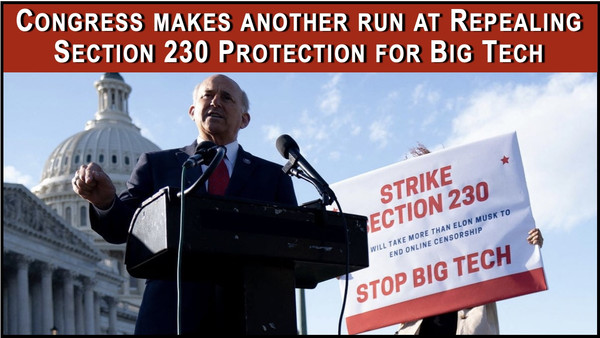
Bipartisan Bill Seeks to Repeal Section 230
Every Other Corporation and Industry in the US can be sued if they harm you - Except Internet Companies!
By Christina Mass, ReclaimtheNet.org, December 22, 2025
A proposal in the US Senate titled the Sunset Section 230 Act seeks to dismantle one of the core protections that has shaped the modern internet.
Put forward by Senator Lindsey Graham with bipartisan backing from Senators Dick Durbin, Josh Hawley, Amy Klobuchar, and Richard Blumenthal, the bill would repeal Section 230 of the Communications Act of 1934, a provision that has, for nearly thirty years, shielded online platforms from liability for the actions of their users.
We obtained a copy of the bill for you here.
Under the plan, Section 230 would be fully repealed two years after the bill’s passage.
This short transition period would force websites, social platforms, and hosting services to rethink how they handle public interaction.
The current statute stops courts from holding online platforms legally responsible as the publishers of material shared by their users.
Its protection has been instrumental in allowing everything from local discussion boards to global platforms such as YouTube and Wikipedia to operate without being sued over every user comment or upload.
The legislation’s text removes Section 230 entirely and makes “conforming amendments” across multiple federal laws.
“I am extremely pleased that there is such wide and deep bipartisan support for repealing Section 230, which protects social media companies from being sued by the people whose lives they destroy.
Giant social media platforms are unregulated, immune from lawsuits, and are making billions of dollars in advertising revenue off some of the most unsavory content and criminal activity imaginable,” said Senator Graham.
“It is past time to allow those who have been harmed by these behemoths to have their day in court.”
Senator Graham’s statement reflects growing political hostility toward Section 230, but the premise behind his argument collapses under close examination of how the law actually functions.
The Tech Industry Claims: The idea that repealing Section 230 would meaningfully hold large tech platforms accountable misunderstands both the legal structure of the internet and the purpose of the statute.
Section 230 does not grant “immunity” in the sense that companies cannot be sued for their own actions. Platforms can and routinely are sued for violating federal criminal law, intellectual property rights, or contractual obligations.
What the statute prevents is liability for speech created by its users.
Without that safeguard, every website hosting user comments, reviews, or uploads would risk litigation for each post. A total repeal would not just affect Facebook or YouTube; it would reach tiny community forums, news sites with comment sections, local businesses that host user feedback, and nonprofit educational networks.
READ: Hawley calls for repeal of tech legal shield as AI rises
Blackburn’s claim that Big Tech uses Section 230 “to censor conservative voices” misunderstands both the law and the First Amendment.
Section 230 does not require or authorize any specific content decision. It simply prevents lawsuits over moderation choices, whether those affect conservative, liberal, or apolitical content. (Editor's Note: That IS the Problem! Big Tech DID and can pick winners and losers, with real damages of millions of dollars to Conservative Podcasters and Social Media Influencers with TOTAL IMMUNITY!)
Even though major social media platforms censored conservative voices over the last decade, repeal of Section 230 would not create political neutrality; it would compel platforms to err on the side of suppression, further constraining speech across the spectrum.
Senator Blumenthal’s suggestion that companies “hide behind Section 230 to dodge accountability” overlooks existing accountability mechanisms. Platforms can already be sued for their own misconduct, such as defective design, deceptive practices, or failure to comply with federal reporting obligations.
Section 230 only blocks suits that attempt to treat a platform as the publisher of another person’s speech, a boundary drawn to preserve open dialogue while still permitting enforcement of genuine legal violations.
Graham went further on Fox News: “These platforms are doing enormous damage to our country, pushing people to suicide and selling fentanyl-laced pills and tablets,” Graham said.
“It is long past time to open up the American courtroom to those who have been harmed by this out-of-control system, and to finally have regulations and accountability for the largest businesses in the history of the country. The courthouse doors are closed, and there is no meaningful regulation.”
Click Here to Watch/Listen to the Newest We the People Convention Weekly News & Opinion Podcast!
Senator Graham’s argument combines real public concerns with a deeply mistaken premise about how the internet and US law operate.
The harms he lists, suicide, drug trafficking, and unregulated digital power, are serious, but none of them exist because of Section 230. . . .
If Section 230 were repealed, platforms would not become more accountable; they would become more restrictive.
Legal exposure would force them to monitor and filter user activity on an unprecedented scale, removing controversial, sensitive, or even tragic personal content to avoid potential lawsuits. (Editor's Note: But is WOULD force them to treat everyone fairly and perhaps even advance the truth like newspaper editors used to do by requiring multiple sources before publishing a story and differentiating between "news" and "opinion"!)
What Senator Graham calls an “out-of-control system” is in fact an information ecosystem dependent on a single legal distinction: that people are responsible for what they say, and that the conduit carrying their speech is not the publisher of it. Erasing that line will not prevent tragedy. It will only replace open networks with a censored and legally paralyzed internet where fewer people dare to speak at all.
