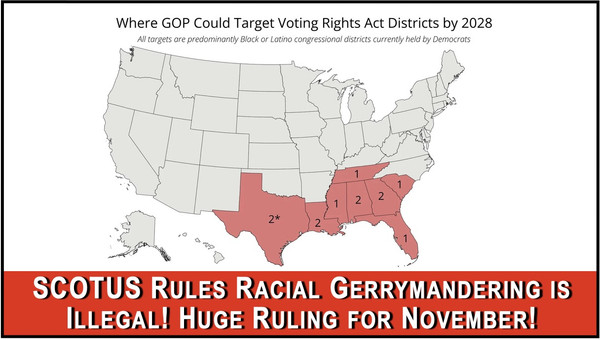
Louisiana case ends racial gerrymandering, as redistricting and legal battles ramp up - HUGE Win for MAGA!
Breaking: US Supreme Court Allows Louisiana Redistricting Ruling to Take Effect Immediately
by Just the News.com, April 29, 2026
A New Era of Constant Redistricting
Mid-decade redistricting—once rare and typically considered extraordinary—has become increasingly common. Lawmakers in both parties are redrawing congressional boundaries outside the traditional once-a-decade cycle, citing population shifts, court rulings, and changing political conditions.
“I’ve never run in the same district twice. That is how far things have gone when it comes to gerrymandering," Louisiana GOP Rep. Julia Letlow said on the John Solomon Reports podcast hours after the Supreme Court on Wednesday issued a 6-3 ruling striking down Louisiana’s congressional map on the ground that the state’s creation of a second majority-black district constituted an unconstitutional racial gerrymander.
The landmark ruling is expected to have sweeping implications for redistricting nationwide.
The surge in redistricting has produced a sprawling web of litigation. Republican National Committee (RNC) Chairman Joe Gruters told Just the News earlier this month that the party is involved in “30 lawsuits across 32 states,” adding that Republicans are trying to act proactively to combat what he described as aggressive efforts by Democrats.
The legal challenges from both sides involve a range of claims, including racial discrimination, partisan gerrymandering, and procedural violations. With primary elections approaching in some states, courts face growing pressure to issue timely rulings. Several cases appear likely to stretch into the summer on appeal, raising the possibility of emergency intervention by the U.S. Supreme Court.
BREAKING: Democrats in full meltdown mode after CNN drops bombshell... They've hit the absolute limit on gerrymandering tricks and are still trailing badly in polls ahead of the 2026 midterms.
— Gunther Eagleman™ (@GuntherEagleman) October 15, 2025
The Democrat Party has COLLAPSED! pic.twitter.com/ko4Rm1TWEn
Many of the cases – some decided and some still pending – could reshape electoral maps in several battleground states ahead of the 2026 midterms.
Louisiana v. Callais: A Transformative Ruling from the High Court
The Louisiana case, Louisiana v. Callais, centered on whether the state, in attempting to comply with Section 2 of the Voting Rights Act, relied too heavily on race in drawing district lines.
BREAKING OVERNIGHT: Louisiana Gov. Jeff Landry (R) plans to suspend the May 16 primary elections so lawmakers can redraw the congressional map after the Supreme Court ruling, per Reuters.
— Election Wizard (@ElectionWiz) April 30, 2026
An announcement could come as soon as Friday.
Do you support this potential move? pic.twitter.com/7W7yI5GDOH
A three-judge federal panel had previously found that the district’s unusual configuration subordinated traditional redistricting principles to racial considerations. In a majority opinion written by Justice Alito, the Supreme Court affirmed that lower court ruling.
Virginia: Ballot Victory Meets Legal Resistance
In Virginia, voters narrowly approved a Democratic-backed constitutional amendment on April 21 that would temporarily allow the General Assembly to redraw congressional districts ahead of the 2026 midterms.
Supporters framed the measure as a one-time effort to “restore fairness.” It passed with about 51.7% of the vote and could shift the state’s 11-member House delegation toward Democrats.
The amendment, however, is facing several legal challenges. Lawsuits backed by Republican lawmakers and allied groups argue that Democratic legislators improperly extended a special session and bypassed various procedural and constitutional requirements.
Soon after the election, a Tazewell County circuit judge ordered the state to halt certification of the referendum results pending review by the Virginia Supreme Court. The ruling cast uncertainty over the amendment’s future.
Virginia Attorney General Jay Jones appealed the ruling, and the state’s high court heard arguments earlier this week. In a brief order issued Tuesday, the court declined to lift the lower court’s hold – leaving certification paused for now.
The court must still decide whether to uphold or strike down the amendment. Additional federal challenges are expected regardless of the outcome.
Texas: Supreme Court Clears GOP Map
On April 27, the U.S. Supreme Court issued a summary reversal in a closely watched Texas case, allowing the Republican-controlled Legislature’s 2025 mid-decade congressional map to take effect for the 2026 elections. The liberal justices – Justices Sonia Sotomayor, Elena Kagan, and Ketanji Brown Jackson – dissented.
The decision overturned a lower federal court injunction that had blocked the map on racial-gerrymandering grounds. The lower court had concluded that race predominated in drawing several districts, in violation of the Equal Protection Clause.
The decision is expected to bolster Republican efforts to expand their narrow House majority.
Florida: New Proposal Sets Up Legal Fight
Also on April 27, Florida GOP Gov. Ron DeSantis unveiled a proposed congressional map that could add up to four Republican-leaning seats, potentially expanding the state’s GOP advantage in the House delegation.
Released just 24 hours before a special legislative session, the proposal redraws districts in Central and South Florida, pairing some Democratic incumbents and extending Republican-leaning suburbs into more favorable districts. DeSantis described the plan as aligning representation with the state’s current political landscape.
BREAKING: The new Florida map has passed in the state senate — It now heads to DeSantis' desk to be signed into law! pic.twitter.com/amdskUmvsj
— Townhall.com (@townhallcom) April 29, 2026
The proposal immediately drew criticism, with opponents calling it a partisan gerrymander in violation of Florida’s constitutional ban on maps designed to favor a political party.
But the map is expected to pass during the special legislative session and could be used in the midterms if it survives court challenges.
Lawsuits from Democratic organizations are widely expected, particularly given that Florida courts have struck down similar maps in recent years.
The Stakes Ahead
These and other pending disputes illustrate how redistricting has evolved from a once-per-decade administrative process into a continuous political and legal contest.
CLICK: California’s Prop 50 plans thrown into chaos after bombshell Supreme Court ruling in Louisiana
With the midterms quickly approaching and control of the House potentially hinging on only a few seats, both parties are pouring significant resources into litigation and mapmaking.
For now, the dozens of pending cases point to a defining reality of American politics: the battle over who draws the lines can be as consequential as the votes cast within them.
