Here’s everything you need to know about Trump Accounts
by Taylor Herzlich, The NY Post.com, January 29, 2026
A growing number of employers are jumping on the bandwagon for Trump Accounts. Here’s everything you need to know about opening one.
Who are Trump Accounts for?
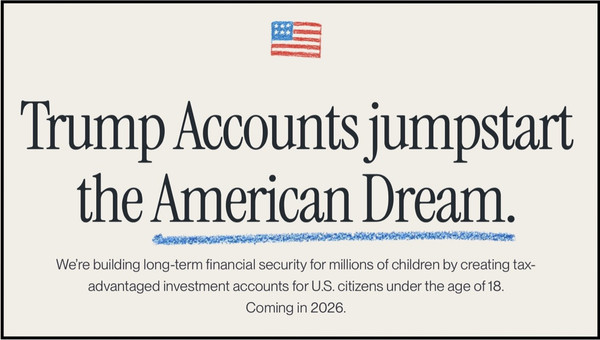
Trump Accounts are for parents and guardians who want to save money for their kids’ educations – or for them to start a business or make a down payment on a home after they turn 18.
Anyone with a kid 18 or younger who is a US citizen with a Social Security number can open a Trump Account. The federal government will contribute $1,000 in seed money per account – but only for kids born from Jan. 1, 2025, to Dec. 31, 2028.
What do Trump Accounts do?
Parents, family members and friends can contribute up to $5,000 total per year to a Trump Account. Half of that can come from pre-tax income. Any contributions from the government or charities don’t count toward the $5,000.
Employers can contribute up to $2,500 per year for the kid of an employee or of an employee’s dependent — that counts toward the $5,000 annual cap, but won’t be considered taxable income. Employers can also let workers direct up to $2,500 of their pre-tax salaries to Trump Accounts.
“It’s gonna be very similar to a 401K match in the sense that this is just free money,” Nathan Goldman, a member of the American Accounting Association and professor at North Carolina State University, told The Post.
Funds in the accounts can only be invested in low-cost mutual funds or exchange-traded funds, also known as ETFs, which mostly consist of US stocks and bonds.
The website www.trumpaccounts.gov estimates that investing $250 per year in an account opened at birth will yield $20,700 by the time the youth is 18. Annual investments of $5,000 are estimated to yield $303,800 by that age, according to the site.
Funds can’t be withdrawn until the beneficiary turns 18, though there are penalties if the money goes toward expenses other than the ones for which the accounts were designed.
In contrast to other government “social spending,” this program fosters thrift, savings and self-sufficiency.
The way it encourages young folks to gain financial literacy promises a life-changing for coming generations; that’s no doubt why Minaj will add more “starter savings” for kids of her fans, and why others across the private sector, including Ray Dalio and Brad Gerstner (as well as a growing list of major companies), are adding their own donations — with Michael and Susan Dell giving over $6 billion to extend the program’s range to “enroll” kids from lower-income families born the 10 years before 2025.
Unlike giveaways favored by the left, which drive up the national debt and spike inflation, Trump Accounts won’t flood the economy with fresh cash but instead prime the pump of long-term investment — offering a giant blow to inequality and a boost to socio-economic mobility.
Voters may not give Republicans credit this November for launching this fantastic innovation, but it’s still a fantastic step toward promoting the nation’s long-term prosperity.
How do taxes work with Trump Accounts?
Taxes depend on a host of details. If the beneficiary withdraws the funds at age 18 or older for higher education, the withdrawal and and any earnings get treated like income tax.
Similar to an IRA, if the money is taken out before the beneficiary turns 59 and a half for something other than education, starting a business or making a down payment on a first-time home, there are different kinds of penalties.
For instance, if a person takes out funds to buy a car after turning 18, they face a 10% penalty.
But from age 59 and a half onwards, the money can be withdrawn for things other than the intended purposes of Trump Accounts with no penalty – but with income tax still required.
How do Trump Accounts compare with traditional savings accounts?
Trump Accounts do not have the same tax advantages as 529 accounts, which are deferred savings plans designed to help pay for college expenses, or Roth IRAs, retirement plans that enable tax-free withdrawals, experts told The Post.
Unlike those plans, withdrawals from Trump Accounts are not tax-free and the savings must be invested in low-cost index funds.
Still, parents may want to diversify their savings with Trump Accounts – for example, putting 75% of savings in a 529 and keeping 25% in a Trump Account, Goldman said.
Here is a GREAT Idea from a We the People Convention Member - Dick from Cincinnati:
After your January 31 podcast on the Trump Account, I have decided to explore having our church fund the accounts for all new children born from January 1, 2025, to December 31,2028 to members of our congregation. Maybe even cover those currently under 18.
If you are not aware, a contribution to the Trump Account from a charitable organization will not reduce the $5,000 limit so that makes it even better.
“The government seed amount and qualified general contributions (i.e., from charitable organizations) don’t count toward the annual limit, which can make a big difference for eligible families.”
You can find this in the following link:
www.fidelity.com/learning-center/personal-finance/trump-accounts
Dick
List of Billionaires, Banks and Businesses Contributing to Trump Accounts:
Trump and his Treasury Department have announced that dozens of companies—spanning several industries and overseeing millions of employees—will be matching employee contributions to the accounts “in a variety of forms that work best for their employees." Those to have been named include:
- Bank of America
- Bank of New York Mellon
- BlackRock
- Block Inc.
- BNY
- Charles Schwab
- Charter Communications
- Chime Financial
- Chipotle
- Coinbase
- Comcast
- Continental Resources
- Dell Technologies
- IBM
- Intel
- Investment Company Institute
- JPMorgan Chase
- Mastercard
- Nvidia
- Robinhood Markets
- Russel Investments
- SoFi Technologies
- State Street
- Steak ‘n Shake
- Uber
- Visa
- Wells Fargo
“The President foresees a day where matching contributions to Trump Accounts will be as integral to an employee benefits package as a matching 401(k),” Bessent said on Wednesday. And other individuals have said they intend on supplementing the overall pool of funds that will go into these accounts.
Michael and Susan Dell
In December, the billionaire founder of Dell Technologies and his wife pledged over $6 billion to add $250 to the accounts of children aged under 11, who were born before the accounts’ cutoff date of January 1, 2025, and who live in areas where the median income is below $150,000. These children would therefore be technically be ineligible to receive the initial $1,000, though the White House told Newsweek on Thursday that the $250 would be on top of the government's contribution.
How do you open a Trump Account?
You can fill out a new IRS form, known as Form 4547, and attach it to your tax return. There’s a box you can fill in to elect to receive the $1,000 seed money.
Starting around the middle of this year, you’ll also be able to open an account at www.trumpaccounts.gov.
However you choose to open a Trump Account, it won’t be open for contributions until July of this year.
Once you open an account, a financial institution will handle the funds, though the website did not go into detail.
