
Thune Is Lying, Current Senate Rules DO NOT Make SAVE America Act Passage Impossible
The US Senate MUST PASS the SAVE America Act! Call Your Senators - D & R - TODAY and Demand they Listen to the Will of the People who Support Voter ID!
by Alexander Muse, Amuse on X, March 10, 2026
Senate Majority Leader John Thune has argued that passing the SAVE America Act in the face of a threatened talking filibuster would be procedurally impossible. His reasoning is simple. Senate rules, he says, allow unlimited debate and unlimited amendments. If both claims were true, the conclusion would follow. A determined minority could bury the bill in speeches and amendments until the majority surrendered.
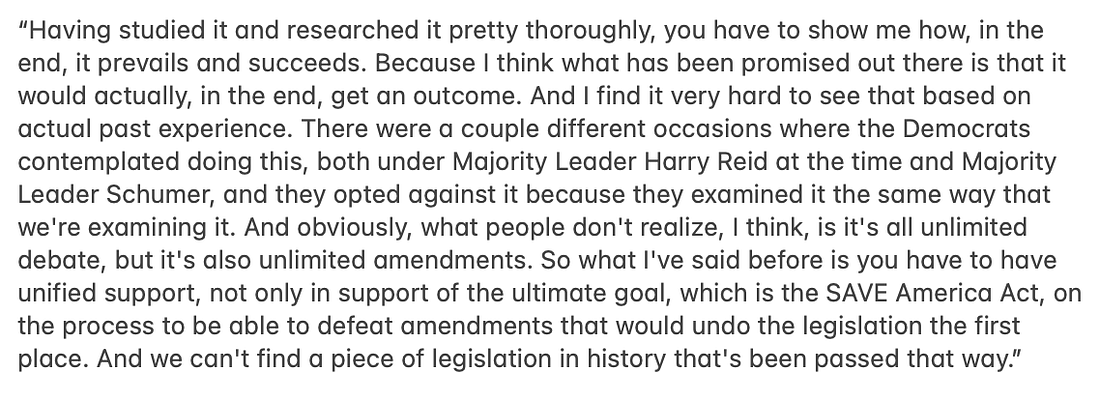 |
Thune describing how passing the Save America Act under current rules is impossible. But the claims are not true.
Debate is not unlimited.
Amendments are not unlimited. Both are bounded by long standing Senate rules and practices that any experienced majority leader understands. The real question is not whether the Senate rules make passage impossible. The real question is whether the majority is willing to use the tools already available to it.
Begin with debate. The phrase “unlimited debate” is often used as shorthand for the Senate filibuster. But the phrase is misleading if taken literally. Senate Rule XIX contains what is called the two speech rule. Under this rule, a senator may speak only twice on the same question during the same legislative day unless the Senate grants permission to speak again. That rule matters because it imposes a structural limit on how often a senator can take the floor on the same matter.
The limit becomes clearer once we understand the concept of a legislative day. A legislative day is not the same thing as a calendar day. The legislative day begins when the Senate adjourns and ends when it adjourns again. If the Senate recesses rather than adjourning, the legislative day continues. That means a legislative day can extend across many calendar days. In principle it could extend for weeks or months.
Now consider what follows from these two rules taken together. Each senator receives two speeches per legislative day on a given question. If the legislative day continues without adjournment, senators eventually exhaust their speeches. They can no longer rise repeatedly on the same matter. Debate can continue for some time because the Senate has many members, but it cannot continue indefinitely through repetition by the same speakers.
The history of the Civil Rights Act of 1964 illustrates how leadership choices shape the length of debate. When the bill reached the Senate floor, Southern Democrats launched one of the longest filibusters in congressional history. Majority Leader Mike Mansfield faced a strategic choice. He could attempt to exhaust the filibustering senators physically by keeping the legislative day open for extended periods. Or he could allow the Senate to adjourn each evening and begin a new legislative day the next morning.
Mansfield chose the second path. By adjourning each day he allowed senators to receive two new speeches every day. Debate therefore continued for roughly sixty days. This choice was deliberate. Mansfield was not trying to crush the filibuster through exhaustion. His goal was to allow debate to unfold while building the bipartisan coalition necessary to reach the two thirds cloture threshold required at the time.
This historical episode shows something important. The duration of a filibuster depends heavily on how the majority structures the legislative day. Mansfield allowed the day to reset because his strategy required prolonged debate. But a majority leader who wishes to limit speeches can simply keep the legislative day open. In that case the two speech rule steadily constrains the supply of available speeches.
The Dems Can't Make "Unlimited Amendments"
The second claim made by Thune concerns amendments. Here the misunderstanding is even greater. Many observers imagine the Senate floor as a place where senators can rise endlessly and offer amendments one after another without constraint. In reality Senate procedure uses a structure known as the amendment tree. This structure determines how many amendments may be pending at any given time.
The easiest way to understand the amendment tree is through analogy. Imagine a literal tree with branches. Each branch represents a possible amendment slot. Once every branch is occupied, the tree is full. When the tree is full, no additional amendments are in order. Senators must first dispose of an existing amendment before another can be offered.
For a typical Senate bill, the full amendment tree contains fifteen theoretical amendment positions. The precise configuration depends on whether the first amendment is a first degree amendment, a substitute amendment, or a motion to strike. But the central point does not change. The number of amendment slots is finite. Once the slots are filled, the Senate cannot consider additional amendments until one of the existing amendments is resolved.
This procedural structure has an important consequence. The majority leader enjoys priority recognition on the Senate floor. When multiple senators seek recognition, the presiding officer traditionally recognizes the majority leader first. Because of this privilege, the majority leader can offer amendments sequentially and occupy the available slots in the amendment tree before the minority has a chance to act.
This tactic is known as filling the amendment tree. Once the tree is filled, the minority cannot offer additional amendments unless the majority chooses to allow it. The amendment queue is effectively closed. The Senate must vote on or dispose of the existing amendments before any new amendments can be proposed.
Both parties have used this tactic repeatedly. During the Obama administration, Majority Leader Harry Reid filled the amendment tree frequently in order to block Republican amendments. Later, when Republicans controlled the Senate, Majority Leader Mitch McConnell used the same tactic to block Democratic amendments. In many of those cases the minority received zero amendment votes.
Understanding this practice clarifies why the phrase unlimited amendments is misleading. The Senate does not allow an endless stream of amendments to accumulate simultaneously. The amendment tree imposes a cap. If the majority fills the tree and refuses to open it, the minority cannot force votes on new amendments.
So What is REALLY the Problem for the Thune and Republican Senators?
Seen in this light, the procedural landscape becomes clearer. Debate is bounded by the two speech rule. Amendments are bounded by the amendment tree. Both constraints have existed for decades and have been used by both parties. Neither constraint guarantees swift passage of legislation. But both demonstrate that the Senate rules do not create an infinite procedural battlefield.
What then explains Thune’s warning? The most plausible explanation concerns political discipline rather than procedural possibility. Since 1975 the Senate has largely operated under what is commonly called the silent filibuster. Senators no longer need to physically hold the floor for days or weeks. Instead a minority can signal its intent to filibuster and the majority agrees to assemble 60 votes for cloture. This modern arrangement isn’t an actual rule but a tradition and requires almost no effort from the minority. A talking filibuster would be different. Senators would need to remain on the floor, speak, coordinate shifts, and physically sustain the debate.
That takes time, and time is the Senate’s most valuable currency. Modern senators devote enormous portions of their schedules to fundraising. A prolonged talking filibuster interferes with that routine. It forces senators to remain in the chamber instead of dialing donors or attending campaign events. Leadership would need to keep members present, fill the amendment tree quickly and keep it filled, and table or defeat whatever hostile amendments reach the floor.
Either way the obstacle is not procedural impossibility. It is a reluctance to perform the demanding part of the job. Senators have not truly had to do that work since the silent filibuster culture took hold in the 1970s, when disco was still fashionable. What Thune describes as a procedural barrier is better understood as a test of whether modern senators are willing to do the job the institution once required of them.
More than 85% of the American people and the president are demanding that the Senate secure our elections now. If the majority treats that demand with the seriousness it deserves, and if it is willing to expend the time and effort required by the institution it serves, then the SAVE America Act will pass. The only real question is whether the majority is willing to do the work.
