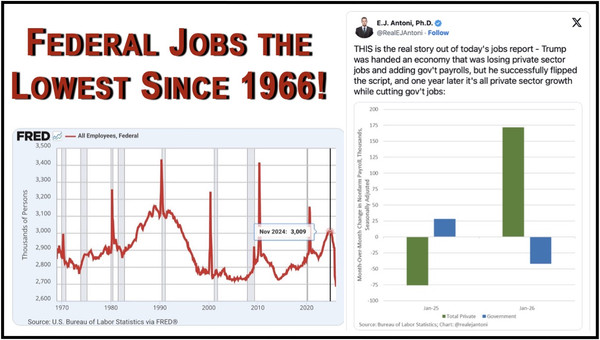
Federal Employment at Lowest Point Since 1966 As DOGE Reductions Take Hold
by Ben Smith, Redstate.com, February 12, 2026
Federal employment dropped to 2,686,000 in January 2026, according to the U.S. Bureau of Labor Statistics. That number has not appeared in federal labor data since Lyndon B. Johnson was in the White House.
The Bureau’s “All Employees, Federal” series confirms it. We have not seen staffing levels this low since May 1966.
For a long time, the working assumption in Washington was that the federal government only grows. Agencies expand. Programs multiply. Headcount inches upward year after year. Rarely does it move the other way.
This time, it did.
The change took shape during President Donald Trump’s second term, when he signed an executive order establishing the Department of Government Efficiency, or DOGE. Publicly associated with Elon Musk, the effort focused on trimming bureaucracy, cutting back administrative layers, and consolidating duplicative functions across federal agencies.
.@SecScottBessent on the blockbuster January jobs report: "This is what we've been setting the table for for all of 2025... There were more than 170,000 private sector jobs, and there was about a 40,000 decrease in government jobs... we are re-privatizing the economy." pic.twitter.com/wwI1D4Cbf6
— Rapid Response 47 (@RapidResponse47) February 11, 2026
According to Office of Personnel Management data summarized in public reporting, more than 322,000 federal employees left the government workforce during the first year after Trump returned to office.
“During which 322,049 federal government employees have exited the workforce. It is the largest reduction of the federal workforce in the past two decades, according to data from the Office of Personnel Management.”
Those exits came in different forms. Roughly 149,500 resigned. More than 105,000 retired. Around 10,500 were laid off. Even after new hires were added, overall staffing declined noticeably.
And it was not limited to a single agency tucked away from public view.
Defense and Veterans Affairs, two of the largest federal employers, saw tens of thousands depart. Health and Human Services announced plans to reduce its workforce from 82,000 full-time employees to 62,000. USAID’s staffing drop was particularly steep, falling from 4,800 employees to just 378. The Department of Education trimmed more than 1,700 positions, landing at roughly 2,500 employees in early 2025.
“USAID was the agency with the highest overall percentage decrease, seeing a reduction of its workforce by 92%… The agency went from 4,800 employees in 2024 to now having 378 employees.”
(USAID has since been folded into the State Department.)
Look at any one of those reductions in isolation, and it may not feel historic. A few here. A few dozen there.
But federal staffing does not shrink in a single dramatic sweep. It changes through attrition, hiring pauses, buyouts, reorganizations, and the quiet removal of programs that no longer receive funding. Those decisions do not always make headlines. They accumulate.
This fact alone deserves the attention of every mainstream media reporter today: https://t.co/cyA26oMEkU
— Karoline Leavitt (@PressSec) February 11, 2026
Eventually, the bigger number reflects it.
The Bureau of Labor Statistics now shows the result. Federal employment stands at 2,686,000, the lowest level in nearly sixty years.
That does not mean Washington suddenly became small. Federal spending remains substantial. Entitlement programs, procurement, and debt service still dominate the budget. Payroll is only one piece of a much larger machine.
Still, the size of the federal workforce matters. It reflects how many people the government directly employs to regulate, administer, enforce, and manage its reach.
For decades, small government conservatives argued that the federal bureaucracy had grown beyond its proper bounds. Many insisted it would never meaningfully contract.
Now the payroll sits at a level last seen in the mid-1960s.
Not every administration leaves behind a measurable shift in federal employment data. This one will.
Shrinking the federal workforce was once treated as theoretical.
It is now a line item in the labor data.
