The Data Center Next Door Has Been There for Decades, You Just Never Noticed
I Built Data Centers in Six Downtowns. Nobody Ever Complained.
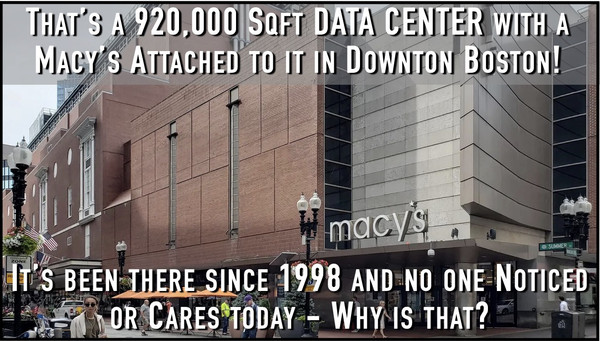
ALEXANDER MUSE JUL 16, 2026There is a building in downtown Boston where you can buy a suit at Macy's, ride the subway home to a 442-unit condominium tower next door, and never once suspect that the structure you just walked past is the most important telecommunications facility in New England. One Summer Street was built in 1949, converted to a data center in the late 1990s, and now houses roughly 920,000 square feet of data center connecting more than 100 network providers. It is not hidden behind razor wire in a distant industrial park. It is embedded in the Downtown Crossing retail core, and the neighborhood never noticed because there was nothing to notice.
The data center at 1 Summer Street in Boston, Massachusetts is a retrofitted 5-story building that was constructed in 1949 and converted into a data center facility in 1998. Situated on a 2.5-acre site, this building spans 920,000 square feet of data center and office space in downtown Boston. Macy's is colocated with the data center.
That building is the answer to a question now being litigated in county boards and city councils across America: can data centers coexist with homes, businesses, hotels, restaurants, and active downtowns? Activists insist they cannot. They describe the facilities as too loud, too bright, too dangerous, too industrial for ordinary community life. The claim sounds plausible if you have never looked at the physical record. Once you look, it collapses.
Consider an audit of 25 major data centers located in major US cities, the continuously operating interconnection facilities where dozens or hundreds of networks physically meet and thousands of computer servers are housed. These are not lightly used server closets. They handle internet, cloud, financial, media, and enterprise traffic around the clock. The 25 facilities operate in 19 cities across 15 states. Twenty-two of them, or 88%, are wholly or partly housed in retrofitted buildings, old printing plants, department stores, postal facilities, warehouses, and office towers. Thirteen, or 52%, occupy structures built in 1949 or earlier. Six operate in buildings constructed between 1910 and 1917. Every single one has apartments, condominiums, hotels, restaurants, grocery stores, offices, schools, arenas, or transit stations in its immediate environment. Several have those uses in the same building.
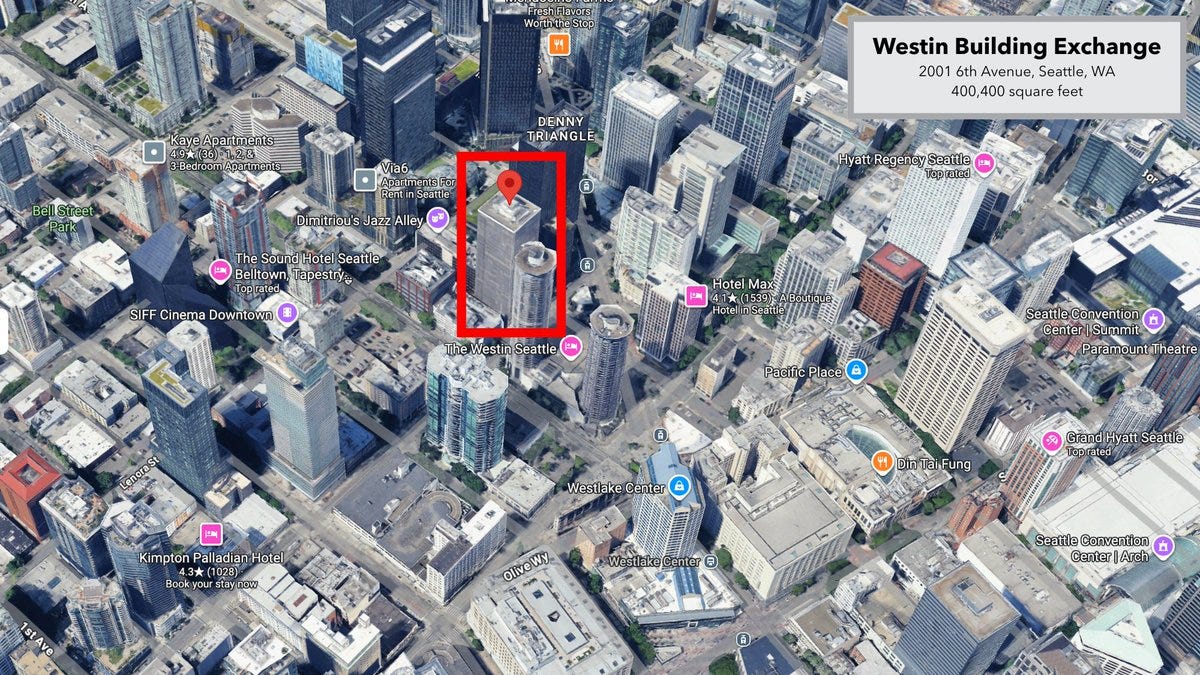
The data center, known as the Westin Building Exchange, is located at 2001 6th Avenue in Seattle, Washington. Situated on a 0.7-acre site, this retrofitted 34-story building was constructed in 1981, renovated in 2007, and spans 400,400 square feet of data center, and colocation/telecommunications space.
Start in Seattle, because Seattle supplies the most literal rebuttal available. The Westin Building Exchange is a 34-story, 400,400 square foot data center home to thousands of servers, more than 150 carriers and 220 networks, and landing points for ten subsea cable routes serving Asia, Australia, and New Zealand. It is connected by skybridge to the 891-room Westin Seattle hotel. Guests sleep, dine, and hold conferences in a building physically attached to one of the heaviest concentrations of digital infrastructure on the West Coast. Amazon's Doppler headquarters stands immediately adjacent. The Via6 apartments occupy the same corridor. If data centers were incompatible with sleep, the Westin would have failed decades ago.
The pattern repeats everywhere. In Los Angeles, One Wilshire has 661,553 square feet of data center space and connects more than 300 providers from a 1967 office tower surrounded by the Hotel Per La, the Brockman Lofts, and the restaurants of the downtown grid. A few blocks away, CoreSite's 424,890 square foot data center facility at 900 North Alameda faces Union Station, the Mozaic apartments, and Philippe the Original, a restaurant that has been serving French dip sandwiches since before the First World War. In Chicago, the 1.13-million-square-foot data center located in a former printing plant at 350 East Cermak anchors a South Loop district that includes the Marriott Marquis and the Arrive LEX apartments.
In Newark, a 1912 department store that once housed Macy's commerce now houses more than 360,000 square feet of data-center space beside Prudential Center and the residences of Teachers Village. In Portland, the Pittock Block is itself a mixed-use property, with 200,000 square feet of data infrastructure along with another 100,000 square feet of offices, and retail in one building and a famous food-cart pod across the street. Dallas, Denver, Miami, Minneapolis, Kansas City, Phoenix, Atlanta, Palo Alto, San Jose. The list runs on, and in every city the story is identical: hotels welcome guests, residents sign leases, restaurants seat diners, and data moves silently through the building next door.
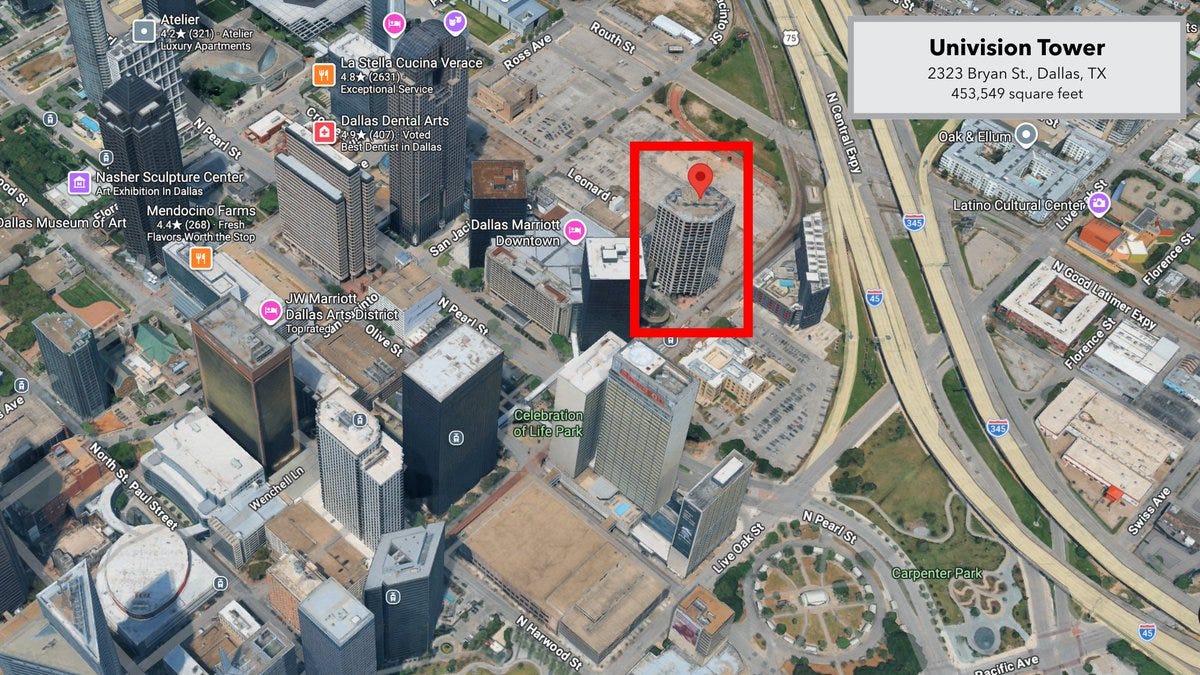
2323 Bryan Street is where I built my first data center when I was in my late 20s. It was beautiful - raised floors, cobalt blue server cabinets, and amazing cable management. Known as the Univision Tower, this retrofitted 26-story building was constructed in 1983 and spans 453,549 square feet of data center space. Equinix bought our facility in Suite 1400, which it now refers to as its DA4 data center. Through DA4, Equinix provides access to 20 networks.
I know this record intimately because I helped build it. As a young entrepreneur I was founder and CEO of LayerOne, a venture-backed data center company, and we built facilities in the heart of Chicago, New York, Miami, St. Louis, Dallas, and Los Angeles. No one ever complained. Not once. Those facilities are all still operating today, and I would wager that 99% of the people who walk past them have no idea they are passing what activists now describe as an evil, dangerous data center. The only water our facilities consumed went to the restrooms and kitchens we provided for our engineers. We paid for all of the electrical switch gear necessary to power our buildings, and the electric company was more than happy to gain another paying customer. The idea that we were imposing hidden burdens on our neighbors would have struck everyone involved, the city, the utility, the landlords, the tenants upstairs, as bizarre.
Click Here to Donate to Support the Efforts of the We the People Convention's Mission to Protect and Defend YOUR Individual Freedom, Liberty and Prosperity!
A skeptical reader will ask the fair question: what about noise? What about the generators? Here the record is equally instructive, because the concern has been measured, engineered, and resolved. When Equinix proposed its SV10 and SV11 facilities at Great Oaks in San Jose, the planning record identified existing residences roughly 320 feet away. The city did not respond with slogans. It applied enforceable numerical standards, 55 dBA at residential boundaries and 60 dBA at commercial ones, and required an acoustical analysis. The preliminary study found that generator testing needed mitigation. The remedy was not prohibition. It was engineering: acoustically rated generator packages and an acoustically lined 25-foot screen wall.
The reviewing engineer, David Hessler, concluded that the final design appeared to satisfy the noise requirements at all site boundaries. That is how serious government works. Measure, engineer, verify, build. Phoenix followed the same logic, noting in a land-use document that backup generators are typically tested monthly for three to five minutes. Fairfax County’s 2024 zoning rules require operational equipment to be fully enclosed or screened. Noise is not an unknowable menace, it is a design variable, and any planning department that pretends otherwise is choosing hysteria over competance.
The safety objection fares no better, these facilities are governed by UL 9540A fire testing for battery systems, UL 1778 certification for uninterruptible power supplies, OSHA battery-room requirements, NFPA standards, local fire codes, insurer engineering reviews, and FM’s comprehensive January 2026 loss-prevention standard covering everything from cable penetrations to emergency planning, which makes a modern data center one of the most intensively engineered and inspected classes of commercial property in the country rather than the unregulated hazard of activist imagination. A building subject to that regime is safer than most of the structures its critics live and work in.
CLICK HERE TO READ THE REST OF THIS ARTICLE AND SUBCRIBE TO HIS SUBSTACK
