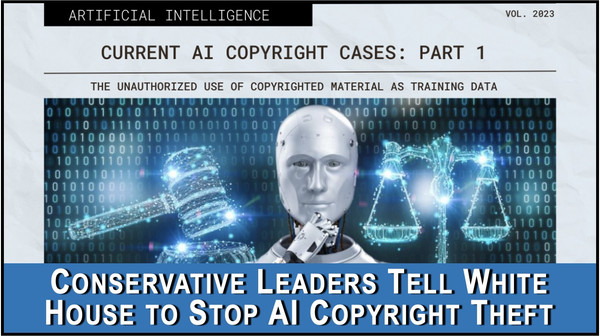
Bannon and other top conservatives urge White House to reject Big Tech’s ‘fair use’ push to justify AI copyright theft: ‘Un-American and absurd’
Click Here to send YOUR message to President Trump asking him to Protect American Copyright Holders!
December 1, 2025
The Honorable Pam Bondi
Attorney General of the United States
U.S. Department of Justice
950 Pennsylvania Avenue, NW
Washington, DC 20530-0001
The Honorable Michael Kratsios
Director, Office of Science and Technology Policy
Eisenhower Executive Office Building
1650 Pennsylvania Avenue, NW
Washington, DC 20504
Dear Attorney General Bondi and Director Kratsios:
Big Tech says it is “fair use” under our federal copyright laws for them to steal and profit from every creative work in America to “train” or otherwise benefit their artificial intelligence machines. “We must steal like China to compete against China,” they essentially argue. This is un-American and absurd. We must compete and win the global AI race the American way—by ensuring we protect creators, children, conservatives, and communities.
We, the undersigned conservative and America First advocates, urge you to reject calls by progressive groups and special interests to intervene in copyright litigation on behalf of alleged infringers. Such intervention would harm American workers, contradict the Trump Administration’s artificial intelligence (AI) and trade policy, weaken U.S. soft power, and promote China’s economic espionage.
Intellectual property is deeply rooted in the U.S. Constitution, conservative legal principles, and the rule of law. The Framers of the Constitution established the power of Congress to protect intellectual property in Article I, Section 8. The First Congress enacted the Copyright Act of 1790. These founders understood copyright as a property right essential to promoting economic growth and the incentive to create and disseminate ideas. While anti-copyright interests lament the cost of damages for infringement, those damages—and their deterrent effect—are a necessary feature of copyright law, the purpose of which is to incentivize the production of creative works.
Indeed, the founders’ foresight is reflected in our economy today. Core copyright industries account for over $2 trillion in U.S. GDP, 11.6 million workers, and an average annual wage of over $140,000 per year—far above the average American wage. American copyright holders sell over $270 billion in overseas markets, contributing to a $37 billion trade surplus. Protecting and exporting U.S. intellectual property (IP) is existential to our economy and a critical component of President Trump’s efforts to raise American wages, reduce America’s trade deficit, and promote fair trade writ large.
The Administration’s Office of the United States Trade Representative (USTR) released a report this year urging trading partners to “stop those stealing the intellectual property of hard-working businesses and individuals,” noting the president’s “track record of empowering our innovators and workers.” The report notes China’s longstanding efforts to weaken American IP, including through theft of trade secrets, forced technology transfer, and counterfeiting. The FBI estimates the U.S. economy loses up to $600 billion per year in IP theft and infringement—with China by far the worst offender. Granting U.S. AI companies a blanket license to steal would bless our adversaries to do the same—and undermine decades of work to combat China’s economic warfare.
Opponents of applying copyright law to AI make a series of flawed claims in an effort to cut corners. One is that competition with China requires the U.S. to abandon its commitment to strong IP protections. This is particularly ironic, as experts at the Center for Strategic and International Studies note that China relentlessly steals IP from the United States while simultaneously working to strengthen its own IP system. Far from a hindrance to AI leadership, China understands well that strong IP protections are one of America’s key economic advantages. Degrading IP rights domestically would enable China and other adversaries to avail themselves of the same dubious “fair use” theories to not only steal creative content, but also proprietary U.S. AI models and algorithms. Establishing that precedent would be dangerous and could have negative ramifications for countless industries.
Other commenters and tech interests argue that licensing is too impractical or costly for AI development. This claim is belied by the actual facts on the ground. The combined market capitalization of the top U.S. hyperscalers—NVIDIA, Microsoft, Apple, Google, Amazon, Meta, Oracle, and IBM—is north of $20 trillion. Prominent American AI startups have valuations in the hundreds of billions of dollars, such as OpenAI, xAI, and Anthropic. U.S. companies are investing over $560 billion in AI development this year alone, which includes over $190 billion in venture capital.
It is absurd to suggest that licensing copyrighted content is a financial hindrance to a $20 trillion industry spending hundreds of billions of dollars per year. AI companies enjoy virtually unlimited access to financing. In a free market, businesses pay for the inputs they need. Imagine if AI CEOs claimed they needed free access to semiconductors, energy, researchers, and developers to build their products—they would be laughed out of their boardrooms.
Important - WATCH Congress Removes AI Amnesty from National Defense Authorization Bill:
AI companies themselves are disproving claims about the impracticability of licensing. The increasing number of deals between copyright owners and AI companies suggest mutual agreement on the value of human-created works to AI development and the ability of the marketplace to determine that value. These deals not only respect the law—they ensure the future viability of creative industries that produce content that supports American AI development.
Still, many claim that unrestricted access to copyrighted works is somehow essential for U.S. national security, as AI companies need access to those works to build applications that will defend the nation and advance American foreign policy. This national security façade is meant to scare policymakers and the judicial system into ignoring or short-circuiting the law for the good of the country.
While AI leadership is undeniably important for U.S. geopolitical goals, one hardly needs a machine-learning degree to question the national security imperative of unlicensed SpongeBob productions or erotic chatbots. If AI companies truly worry for American security, they’ll redirect some of that creative energy into bespoke applications that achieve military objectives. For instance, AI developers could curate and leverage government data sets—like decades of satellite imagery and weather reports—rather than churning out AI slop meant to addict young users and sell their attention to advertisers.
President Trump—himself a bestselling author and former television producer—said it best:
“The pioneering spirit of our artists, authors, inventors, and other creators has improved our lives and the lives of millions of people around the world, and will continue to propel us toward a better future.”
Licensing markets that respect IP and uphold the rule of law will ensure that spirit continues to benefit our economy, advance President Trump’s pro-worker AI policy, and proliferate American culture throughout the world. The Administration should encourage the continued development of those markets and resist calls to stop them in their tracks by intervening in ongoing litigation.
Sincerely,
Mike Davis
President, Article III Project
Stephen K. Bannon
Executive Chairman, WarRoom
Nick Solheim*
Chief Executive Officer, American Moment
Will Chamberlain
Senior Counsel, Article III Project
Aiden Buzzetti
President, Bull Moose Project
Daniel Suhr
President, Center for American Rights
Jeff Mazzella
President, Center for Individual Freedom
Eric Teetsel
Chief Executive Officer, Citizens for Renewing America
Gerard Scimeca
Chairman, Consumer Action for a Strong Economy
Joel Thayer*
President, Digital Progress Institute
Jack Posobiec
Senior Editor, Human Events
Otto Heck
Chief Operating Officer, Internet Accountability Project
Josh Hammer
Host, The Josh Hammer Show
(*Affiliation listed for identification purposes only)
