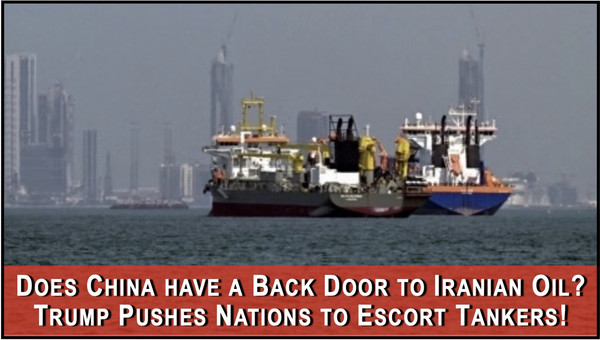
China Continues Importing Iranian Oil Through ‘Backdoor’ Route Bypassing Strait of Hormuz
by Michael Zhuang, The Epoch Time.com, March 16, 2026
China continues to receive Iranian crude oil through alternative routes designed to bypass the Strait of Hormuz, a global energy chokepoint at risk of closure amid the Iran war, according to several China-based industry sources and analysts who spoke to The Epoch Times on condition of anonymity because of fears of reprisal.
One of those routes centers on Iran’s southeastern Jask Port, a relatively new export terminal outside the Strait of Hormuz that allows oil tankers to load crude directly into the Gulf of Oman, avoiding the narrow waterway where military tensions are highest.
A Chinese industry insider familiar with the China–Iran oil trade told The Epoch Times that Iranian oil shipments to China have remained largely unaffected by the conflict.
“Since the outbreak of the war, Iranian crude arriving at ports in [China’s] Shandong and Zhejiang has continued almost normally,” the insider said.
According to the insider, the continued flow of oil is not accidental but the result of contingency planning between Beijing and Tehran before the conflict escalated.
“Before the war began, Beijing had already reached an understanding with senior Iranian officials about how to move oil to China if the situation spiraled out of control,” the insider said. “Most of Iran’s exported crude ultimately ends up in the Chinese market.”
The insider added that shortly before the U.S.–Israeli strikes on Iran began, China’s trade authorities circulated an internal directive to subordinate agencies. The instruction called for preparing for two possible scenarios—one in which Iranian oil supplies are cut off entirely and another involving emergency measures to significantly increase Russian oil imports.
Jask Emerges as New Export Hub
The insider noted that Iran’s Jask Port has become a critical node for maintaining exports during the conflict.The port lies outside the Strait of Hormuz, allowing tankers to sail directly into the Gulf of Oman without passing through the narrow strait.

In an X post on March 13, Financial research platform Global Markets Investor stated that Iran’s crude exports have averaged about 2.1 million barrels per day since the war began, slightly higher than the roughly 2 million barrels per day exported before the conflict.
The insider said a large share of the additional volumes is believed to be heading to China via alternative routes, including Jask.
“At a time when global energy prices are soaring, and many tankers are avoiding the region, vessels linked to China’s so-called shadow fleet remain unusually active in the Gulf of Oman,” the insider said.
Some analysts have said that the continued oil trade reflects deeper geopolitical calculations.
READ: Trump Says Other Nations Joining US Patrols in Strait of Hormuz
A Belgium-based retired Chinese scholar in foreign policy told The Epoch Times that Beijing’s purchases of Iranian oil could provide Tehran with a critical economic lifeline during the conflict.
“The oil flowing to China effectively becomes financial support for Iran’s regime during wartime,” the scholar said.
“While the international community tries to contain expansion and conflict, Beijing is using backdoor channels like Jask to keep funds flowing to Tehran.”
The scholar said that China may also be seeking to secure discounted crude and expand its strategic energy reserves while tensions drive global prices higher.
“Beijing appears to be building an energy security network based on the Axis of Evil in the Middle East conflicts,” the scholar said.
An insider source close to China’s diplomatic corps told The Epoch Times that Beijing began laying the groundwork for an alternative oil transport route from Iran several years ago.
China supported the construction of a roughly 1,000-kilometer pipeline linking the inland oil hub of Goreh to the Jask terminal on the Gulf of Oman, according to the source. The pipeline allows Iranian crude to bypass the Strait of Hormuz entirely before being loaded onto tankers.
“Large volumes of crude oil are now bypassing the easily blockaded Strait of Hormuz and being loaded directly in the Gulf of Oman for shipment to Asia,” the source said.
“This is precisely the wartime backdoor that the Chinese Communist Party reserved to cope with extreme sanctions and potential conflict.”
The source said the project was a part of the sweeping 25-year cooperation agreement signed between China and Iran in 2021.
