White House Considers ‘Pocket Rescissions’ to Sidestep Congress: What to Know
By Jack Richman & Joseph Lord, The Epoch Times.com, July 28, 2025
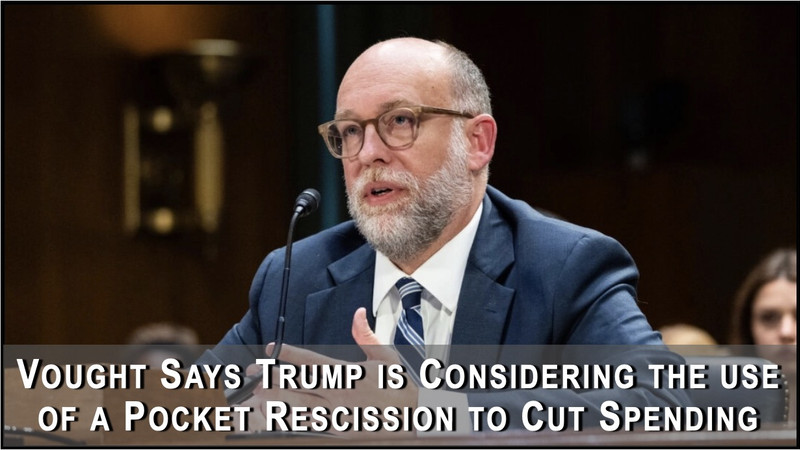
President Donald Trump’s administration is considering a move, called a “pocket rescission,” that would effectively rescind federal funding and potentially bypass congressional approval, Office of Management and Budget Director Russ Vought said on July 27.
The strategy occurs when a president submits a rescission proposal under the Impoundment Control Act—requesting Congress to cancel previously appropriated funds—within 45 days of the end of the fiscal year, Sept. 30. The funds are withheld during the 45-day congressional review period, and if Congress doesn’t act before the fiscal year ends, the funds expire.
When a rescission request is made outside of the fiscal year-end window, if Congress doesn’t act within the 45 days, the funding is released and spending on the impounded program resumes.
“It’s very possible that we might use pocket rescissions. It’s one of our executive tools. It’s been used before,” Vought told CNN’s “State of the Union.”
Critics say that it’s an overreach of executive power and Congress has also expressed concerns about it, but Vought said “the Government Accountability Office ... has said it was legal in the 1970s.”
“That is a fully legal approach to using the Impoundment Control Act, another law [we’re] not too big fans of, to use that to send up a rescissions bill at the end of the year and just have it evaporate at the end of the fiscal year,” Vought said.
CLICK HERE TO WATCH/LISTEN TO THE WE THE PEOPLE CONVENTION WEEKLY NEWS & OPINION PODCAST!
The Impoundment Control Act of 1974 defines the limits of presidential power over federal funding. It prohibits the president from unilaterally canceling funding from a policy or program for ideological or political reasons, a response by Congress to perceived overreaches by President Richard Nixon’s administration. The bill requires the president to submit a request to Congress to cut spending that the administration thinks is no longer necessary or should otherwise be clawed back.
Trump and his allies have questioned the constitutionality of the law, given it is an attempt to set limits on executive power through legislative means. They argue that this violates separation of powers principles and executive prerogative.
The Government Accountability Office states, “Amounts proposed for rescission must be made available for prudent obligation before the amounts expire, even where the 45-day period provided in the [Impoundment Control Act] approaches or spans the date on which funds would expire.”The last pocket rescission request was made in 1983 when the Reagan administration tried to cut $2 million in funding from the National Oceanic and Atmospheric Administration. The request did not become law because it required congressional approval and Congress did not act on it.
On July 18, Congress passed—hours before its deadline—a $9 billion rescissions package submitted by Trump, who subsequently signed it into law on July 24.
Although there could be more rescission requests from the administration, pocket rescissions remain a live option under consideration.
Steven Taylor, a political science professor at American University in Washington, told The Epoch Times that this “accomplishes two objectives” for Trump and Republicans.
“One, it avoids any stonewalling by the Democrats in Congress, and two, it is a way for Republicans in Congress to avoid having to defend unpopular cuts to their constituents,” Taylor said in an email. “With pocket rescissions, members of Congress do not have to worry about their fingerprints being seen on cuts that might damage their image among voters.”
David Bateman, an associate professor of political science at Cornell University, said pocket rescissions “are not a deliberate feature of the impoundment and rescissions process.”
“They are instead an effort to evade the clear intent of that process as established by statute,” he told The Epoch Times.
Richard Bensel, a professor in the department of government at Cornell University, told The Epoch Times that pocket rescissions would reflect Trump’s narrow majorities in the House and Senate and his broad use of executive powers.
Were a pocket rescission to occur, Devin Watkins, an attorney at the Competitive Enterprise Institute think tank, told The Epoch Times, the courts would likely get involved, which seems to be the administration’s ultimate goal.Bateman said it’s unlikely the courts would allow for a pocket rescission to take shape.
“That’s because it is incompatible with the clear intent of the statute, as well as with the broader constitutional principles that the president take care to follow the law and that Congress has power of the purse,” he said.
