The Voting Rights Act Probably Won't Be 'Gutted,' but the Supreme Court Appears Set to Restrain It
by Joe Cunningham, Redstate.com, October 15, 2025
If you only read the headlines after the Supreme Court’s re-argument in Louisiana v. Callais, you’d think conservatives on the Court were sharpening their knives to “gut” the Voting Rights Act. The reality inside the courtroom was more nuanced—and, for those who actually care about constitutional limits, more encouraging.
The justices weren’t preparing to demolish Section 2. They were trying to rescue it from the legal contradictions that have plagued redistricting for forty years.
Section 2’s Growing Tension With the Constitution
Section 2 of the Voting Rights Act prohibits any map or election law that “results” in minority voters having less opportunity than others to elect their candidates of choice. In 1986, the Court’s decision in Thornburg v. Gingles established a three-part test: a large and compact minority population, political cohesion, and majority bloc voting.
In Allen v. Milligan (2023), Chief Justice John Roberts reaffirmed that Section 2 can still require states to draw majority-minority districts under those conditions. But what happens when satisfying Section 2 forces a legislature to make race the overriding factor in its map—a move that violates the Equal Protection Clause?
That’s the core of Louisiana v. Callais.
Democrats have used the Voting Rights Act to rig the system for decades. If the Supreme Court finally fixes this problem, and it looks like they will, Democrats may never win a majority in the House ever again. This is a huge, huge case. https://t.co/oSG3isAxLA
— Matt Walsh (@MattWalshBlog) October 16, 2025
Louisiana’s “No-Way-Out” Problem
Louisiana found itself trapped between two conflicting commands. A federal court instructed the legislature to create a second majority-Black district under Section 2. The moment it did, another set of plaintiffs sued, saying the new map— which passed our legislature as Senate Bill 8—was an unconstitutional racial gerrymander under Shaw v. Reno.
Louisiana Solicitor General J. Benjamin Aguiñaga put it bluntly at argument: “Louisiana would rather not be here… we would rather not be caught between two parties with opposed visions.” His point: the state can’t simultaneously comply with both Section 2’s racial awareness and the Constitution’s racial neutrality without clearer boundaries.
Justice Amy Coney Barrett pressed him on that very distinction: “You don’t understand yourself to be arguing that any part of Section 2 is itself unconstitutional, but rather that the way courts have been applying it goes beyond?” Aguiñaga answered, “That’s correct.”
That exchange cut to the heart of the case we're facing. The debate isn’t over whetherSection 2 is valid—it’s over how far it can go before it crosses into unconstitutional racial sorting.
“Predominance” and the Court’s Search for Limits
The word of the day was predominance—the idea that race becomes constitutionally problematic when it “subordinates traditional, neutral principles” of redistricting and becomes “non-negotiable.” Justice Neil Gorsuch tried to pin down what that means: “Is that a but-for test? A proximate-cause test?” Department of Justice attorney Hashim Mooppan answered, “Neither—it’s when race subordinates neutral principles and cannot be compromised.”
SEE ALSO: Could a SCOTUS Decision in 'Louisiana v. Callais' End Democrat Redistricting Scams Once and for All?
Justice Samuel Alito asked a practical version of the same question: “What about incumbency and partisan advantage? Aren’t those race-neutral factors a legislature is allowed to pursue?” Mooppan agreed—and argued that the current Section 2 doctrine often forces states to discard them, making race predominant by default.
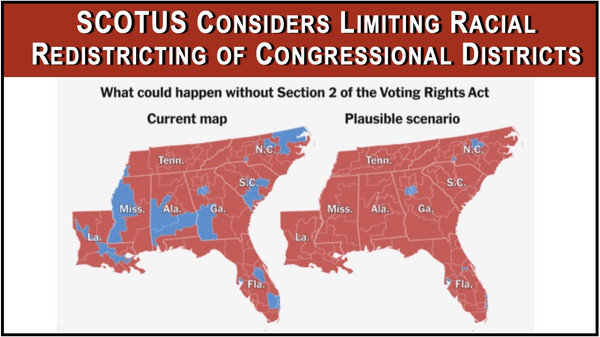
Democrats currently enjoy VERY favorable maps.
— Andrew Follett (@AndrewCFollett) October 16, 2025
New England votes about 40% Republican, and has literally 0 Republican US House members.
Fairer maps might be arriving soon. https://t.co/cRXOjXDRsC pic.twitter.com/KYenE5OzaW
That’s the real constitutional tension the conservative justices want to fix.
The Liberal Response: Protect the Results Test
The Court’s liberal bloc—Justices Kagan, Sotomayor, and Jackson—pushed back hard on any move that looked like rewriting Section 2 itself.
Justice Sotomayor reminded the chamber that “we didn’t grant cert to redo Gingles,” adding that statutory precedents get stronger stare decisis protection because “Congress has had forty years to fix it and hasn’t.” In plain English: Section 2 is a law Congress can change if it wants; the Court shouldn’t do that job for them. Sotomayor appears to be hinting at here that the Court's job is not to create a test for whether or not something is constitutional... which is literally their job.
Justice Jackson tried a broader defense, comparing Section 2’s “effects test” to the Americans with Disabilities Act: “Remedial action absent discriminatory intent is not new… Congress said facilities have to be made equally open… I don’t understand why that’s not what’s happening here.”
🚨 BREAKING: In an insane move, Justice Ketanji Jackson declares we need to draw Congressional districts based on race because black people are like disabled people pic.twitter.com/JGLk7aJKlM
— Eric Daugherty (@EricLDaugh) October 15, 2025
"They don't have equal access to the voting system. They're DISABLED!"
This is utter…
That analogy—comparing race-based districting to wheelchair ramps—fell flat. As attorney Edward Greim (arguing against SB 8) responded, “The difference is that the remedy under the ADA is not stereotyping.” Section 2’s current application, he said, stereotypes voters by race to determine where they “belong.”
A Middle Path Emerging
Between the two poles, the Court’s center-right justices seemed to search for balance. Justice Kavanaugh floated hypotheticals about “tie-breaking” by race; the Chief Justice asked when “outsized” consideration of race becomes too much. None appeared eager to scrap Section 2, but several voiced unease with how it’s being applied.
Even the DOJ conceded that Gingles, as now interpreted, “reaches far beyond anything that reasonably presents a risk of intentional discrimination.”
That’s an acknowledgment that the modern enforcement of the Voting Rights Act needs guardrails. The center-right wing of the Supreme Court is the most likely wing to build those out.
Restricting Isn’t Gutting
The rhetoric you’ll hear in the coming weeks—especially from progressive activists—will sound apocalyptic. But restricting Section 2 to its constitutional limits isn’t the same as gutting it. It’s exactly how constitutional adjudication is supposed to work.
Section 2 was never meant to guarantee racial proportionality in Congress. It was meant to prevent state officials from using race to suppress. Somewhere along the way, compliance with Section 2 began requiring state officials to use race to divide.
That’s what this case seeks to correct.
What Comes Next
However the Court rules, Section 2 will remain on the books. What’s likely to change is the standard for predominance—clarifying when race awareness turns into race domination. That adjustment could pull Section 2 back into alignment with the Fourteenth Amendment rather than against it.
In that sense, the justices aren’t dismantling the Voting Rights Act. They’re performing a constitutional tune-up—tightening a law that’s been running without an alignment for nearly forty years.
