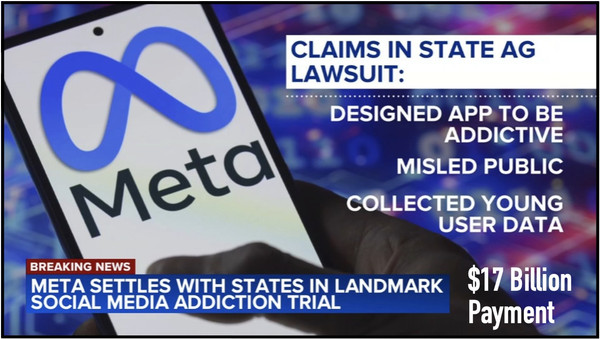
Meta agrees to $17 Billion settlement over claims of child social media addiction and agrees to major changes in how apps work
by Cody Combs, The National News.com, August 26, 2026
Meta, the owner of Facebook, Instagram, WhatsApp and Threads, has agreed to a major settlement over allegations about the addictiveness of its social platforms for children.
According to court filings, the social media giant could pay as much as $17.1 billion to settle the litigation.
The technology company has recently been on the losing end of several US lawsuits that alleged it failed to disclose how younger users could be vulnerable to becoming addicted to its platforms. Meta denies the allegations.
Meta has also been accused of failing to implement adequate safeguards to protect children and teenagers from online predators and other nefarious people.
The We the People Convention Has Been Advocating for Laws to Restrict Social Media Access to Children Under Age 16:
Watch and Read the ALL the Evidence: We MUST BAN Smart Phones & Social Media use by Children
Watch Jordan Peterson and Dr. Haidt: We MUST Stop the Carnage Caused by Social Media!
As a result of the settlement with 47 states, as well as the capital, Washington, and other territories, Meta has also broadly agreed to implement features that would apply to younger users, such as daily time limits, fewer notifications and a cut-off to stop several of its platforms from functioning at night.
“Today, we are announcing an agreement with a bipartisan group of 52 attorneys general across US states, territories, and the District of Columbia, building on our long-standing efforts to empower parents and support teens,” Meta said in a statement on Wednesday.
The company, however, then pivoted in the statement and called out other Big Tech firms that it says teenagers often use.
“For meaningful progress to happen, we urge TikTok and YouTube to join us and state attorneys general in adopting this new standard, to ensure teens use social media in a healthy and responsible way.”
The litigation has been bruising for the company in terms of public perception. Executives taking the stand have been criticised as aloof and indifferent when answering questions about evidence suggesting negligence about how the company's products affected children.
On Tuesday, Instagram boss Adam Mosseri said in the witness box that it was “news to him” that his staffers were often told by a company lawyer to filter out data that gave a closer look at the safety of young users.
Brian Schwalb, Attorney General for District of Columbia, did not mince his words in reaction to the announcement that Meta had agreed to settle.
“Meta intentionally endangered children for profit and then lied about it,” he said. “This is the largest big tech settlement ever.”
Our settlement requires @Meta to adopt sweeping child safety protections on Facebook and Instagram.
— AG Brian Schwalb (@DCAttorneyGen) August 26, 2026
We are setting a new standard for how social media platforms keep kids safe online. pic.twitter.com/eVsTWLreFl
Time limits and a midnight cutoff: Meta’s new rules for kids go further, but critics say not enough
OAKLAND, Calif. (AP) — Kids under 18 will soon see a host of changes to their Instagram and Facebook experiences thanks to a historic $18 billion settlement Meta Platforms reached Wednesday with 48 U.S. states.
Besides the money, which will be paid out over a decade, Meta has agreed to strengthen its age estimates to keep kids under 13 off its platforms and teens in age-appropriate accounts, enact a hard limit of two hours a day for users under 18, block kids from the apps from midnight to 6 a.m., and hide “like” counts, among other changes.
Meta said the new safeguards will only apply in the United States, with most in place for 10 years.
While acknowledging the changes go further than Meta has ever gone when it comes to child safety, critics and children’s advocates cautioned it will not solve its myriad problems overnight.
Arturo Béjar, a former Meta engineering director, said the settlement is a “significant milestone,” but parents should not see Instagram as suddenly safe for children.
“The agreement has a big problem in that it allows Meta to define harm,” Béjar said in an interview Wednesday. “It’s one thing to say, ‘Yeah, you only get like two hours of alcohol or two hours of cigarettes a day,’ but it’s still as bad for you because of what’s getting delivered.”
Béjar, the first witness to testify during the federal trial cut short by the settlement, would like to see Meta address the effect of content recommendations to teens, which he says can prove addictive. While teens might put their phone down when they hit the two-hour limit, they can be distressed about it because the way the platform is designed leaves them craving more.
Meta said people over 18 also can adopt versions of the new controls individually, such as daily time-limit reminders, but there will not be an option for them to opt into the overall settings for what teens experience on the platform.
Who Get's the Money???
The settlement announced today, August 26, 2026, is a little different from the initial headlines. Meta will pay at least $12.1 billion, potentially rising to $17.1 billion if other major social-media companies reach comparable settlements. The money goes primarily to the participating state governments — not directly to individual children or their parents.
The states are supposed to use the money for programs related to the alleged harm to young people. The New York Attorney General, for example, says its share is intended for mental-health services, education programs, grants to schools for phone-free classrooms, training mental-health professionals, after-school and summer programs, and public-health initiatives.
There are some enormous state allocations. New York gets at least $819 million and potentially $1.15 billion; Texas gets more than $1 billion; California could receive roughly $2.1 billion. Georgia expects roughly $100–135 million.
So this is not like a traditional class-action settlement where parents submit a claim and receive a check. In effect, Meta is paying billions into state-controlled funds, with state officials and legislatures ultimately determining how much of that money is spent on programs benefiting children.
What does this Mean for Online Privacy for Adults?
Click Here to Read this in more detail at ReclaimtheNet.orgHere are the 10 main things the article says people should know about the Meta settlement:
- Every Facebook and Instagram user may face age verification — not just teenagers. The settlement requires Meta to apply age-assurance measures to both new and existing users in participating states, potentially using ID checks or facial age estimation.
- Meta agreed not to challenge the settlement on constitutional grounds. The article argues this allows age-verification requirements to avoid some of the First Amendment challenges that have blocked similar state laws.
- If you don't verify your age, Meta can treat you as a teenager. After 14 days without successful age verification, an account can be subject to teen restrictions such as a two-hour daily limit and overnight shutdown.
- States have a financial incentive to get TikTok, YouTube and Snapchat to adopt similar rules. Part of Meta's settlement payments are contingent on competing platforms agreeing to comparable requirements.
- Meta will become better at identifying multiple accounts belonging to the same person. It can use device IDs, email addresses, phone numbers and other signals to connect accounts even when users haven't linked them themselves.
- Reports that someone is underage could trigger additional scrutiny. Meta must make underage reporting easier, and when an under-13 account is removed, it can examine that person's friend network for other potentially underage users.
- Meta will be legally required to restrict certain otherwise lawful content for minors. This can include discussions involving weight, fitness, body image and mental-health experiences, not just obviously dangerous material.
- Some suicide-prevention or eating-disorder recovery accounts could also be blocked from teenagers. The article argues that the settlement's categories may not adequately distinguish between content promoting harmful behavior and content intended to help people recover from it.
- Your searches, likes, saves and group memberships can contribute to Meta labeling an account “potentially suspicious.” Teenagers — and in some cases their parents — can then receive warnings about interactions with those accounts.
- The independent audits won't necessarily be completely transparent. Meta and the states can review the public summary, confidential material can be excluded, and underlying audit materials may eventually be returned or destroyed.
