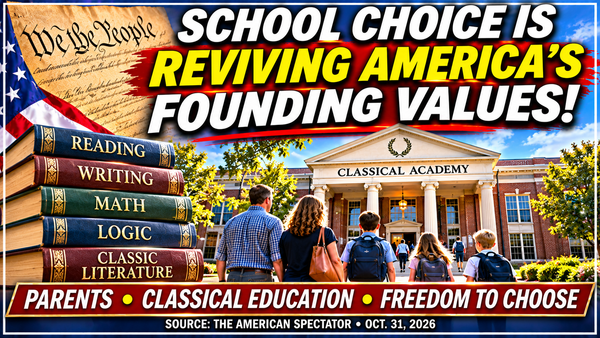
School Choice Is Bringing Back America’s Founding Values
by Lewis M. Andrews, The American Spectator, October 31, 2026
On October 7, Secretary of State Marco Rubio gave a widely covered address in Athens, Greece, which warned that the U.S. and its allies were at a crossroads and needed to reembrace the core values of Western civilization to remain successful countries. Either they adopt the traits of “fierce individuality and relentless ambition; daring exploration and invention; a yearning for discovery, for adventure, risk and glory,” he said, or continue in their misguided pursuit of a world where no one loses. A world where “the potential of the best” is sacrificed to “the comfort of the worst,” and “the most exceptional things among us [become] hostage to the average, the ordinary, the mediocre.”
Judging by the widespread praise for Secretary Rubio’s speech, many Americans certainly agree with comments. But what is it exactly that needs to be done, especially to counter the collectivist outlook which has permeated so many U.S. educational institutions over recent decades?
School choice…. is the quiet means by which average citizens are attempting to preserve … the blessings of an optimistic and aspirational society.
For his part President Trump has taken steps to ensure that colleges and universities at least allow the Western cannon to get a fairer hearing on their campus. In October of 2025, his administration issued its “Compact for Academic Excellence in Higher Education,” which offers preferential consideration in the receipt of government funds to those schools which abide by a specific set of rules. These include a revision of their speech‑related policies to allow for dissenting viewpoints, the elimination of DEI-related criteria in faculty hiring, and a willingness to limit official institutional positions on political and cultural issues.
Many wealthy and influential alumni are also working to expose today’s undergraduates to a more aspirational belief system — and not just by conditioning donations to their own alma matters. For example, Citadel hedge fund founder Ken Griffin, a graduate of Harvard, recently pledged $2 billion to create a separate campus of Carnegie Mellon University which will completely reorganize the higher education model around entrepreneurial efforts to solve social problems.
But interestingly, the development which is doing the most to restore America’s founding values has not even been recognized as a relevant influencer. Like the 1944 GI Bill of Rights, the 1956 Interstate Highway Act, and many other policy innovations from America’s past, what has come to be called “school choice” — letting parents use tax dollars to send their children to nonpublic schools — is a reform whose ripple effects are far more transformative than its legislated purpose.
That people should fail to appreciate the broader cultural implications of giving families more educational options is certainly understandable, given how fast school choice has been adopted around the country. Small experimental programs had been tried for decades in cities like Milwaukee and Cleveland, but it was not until Covid when, as then Arizona Gov. Doug Ducey put it, “parents were able to see what their [public school] children were being taught via Zoom videos” that millions of parents suddenly began demanding an alternative.
Since then, 19 states have adopted universal school choice policies, and a provision of the 2025 Big Beautiful Bill was written to allow every U.S. taxpayer (beginning in 2027) to claim a dollar-for-dollar federal income-tax credit for donating to a nonprofit group which gives away private school scholarships. Even in states where teacher unions have kept school choice laws from being legalized, many parents have discovered that they can create their own low-cost private school by collaboratively homeschooling in a church or other large space which would otherwise go unused during the work week.
For example, a parent-run school in Uxbridge, Massachusetts called DELTIC Prep annually educates 70 to 90 students at a local parish for under $100 per year. And in Bowie, Maryland, the eXtend Homeschool Tutorial project, under the leadership of Kym Kent, educates more than 100 children in everything from third-grade English to high-school chemistry and aviation science at the Judah Temple AME Zion Church.
But its rapid rise is only half of the school choice story. Less well known is just how many of America’s new and expanding nonpublic schools are using a so-called “classical” curriculum — one which emphasizes the mastery of basic skills (reading, writing, and math), logical reasoning (often treated as separate subject), and the great books of Western civilization. Especially those works which inspired America’s Founders, such as Adam Smith’s The Wealth of Nations, Cicero’s De Republica and De Legibus, and Shakespeare’s plays.
As Discovery Institute Senior Fellow Keri D. Ingraham recently noted, school choice has not only expanded the size and number of America’s private and parochial academies, but it has also turned a formerly niche curriculum into the fastest growing segment of K-12 education. By 2024, according to a market analysis by Arcadia Education, more than 1,500 U.S. schools with estimated 677,500 students were using a classical curriculum, while new classical programs were being established at a rate of 5 percent annually. That same year, attendance at the annual meeting of the National Symposium for Classical Education, which brings together interested scholars and curriculum publishers, exploded from just 65 in 2021 to more than 700.
Click Here to Learn How To Start A Hillsdale College Member Classical School
The underlying reason so many nonpublic schools have gravitated to classical coursework began to become clear in 2016, when the State of Indiana decided to subsidize 34,000 poor and minority children to attend private and parochial schools. Asked in an EdChoice Foundation survey what was most attractive feature of the Indiana program, parents of the participating students did not say academics (which came in second) but rather the opportunity for their sons and daughters to absorb a more traditional value system.
As the late Ethics and Public Policy Center fellow Ian Lindquist subsequently observed in a 2019 report for National Affairs, the rapid growth of classical schooling has been an instinctive response by everyday parents to the growing rejection of America’s founding beliefs by many of the country’s leaders. The widespread impression that “every elite institution seems to have turned itself into another combatant in the culture war or an instrument of hyper-aggressive progressivism,” Lindquist wrote, has made these [classical] schools “some of the most successful and thriving educational options in America.”
(Not that classically educated kids sacrifice anything when it comes to conventional measures of academic competence. Recent studies show that they get exceptionally high scores on standardized achievement tests, have superior college acceptance rates, and even outperform on the SAT.)
From the Biblical account of Exodus to Tolkien’s Lord of the Rings, Western literature is replete with stories of how some overlooked social group manages to quietly overcome the destructive influence of an intellectually arrogant power. It is a theme which aptly describes how so many of today’s parents are employing school choice to restore the values Secretary Rubio spoke of in Athens.
In states that still offer no private or parochial school subsidy — or those where the subsidy is only a fraction of the local public school per pupil cost — these mothers and fathers even volunteer some of their free time so that their own tightly budgeted school can run effectively. And by doing so, become real life examples to their children of just how powerful virtues like persistence, self-reliance, and personal responsibility can be.
School choice has clearly revealed itself to be much more than just an education policy. It is the quiet means by which average citizens are attempting to preserve for posterity the blessings of an optimistic and aspirational society.
CLICK HERE TO READ MORE NEWS AT THE SPECTATOR.ORG
