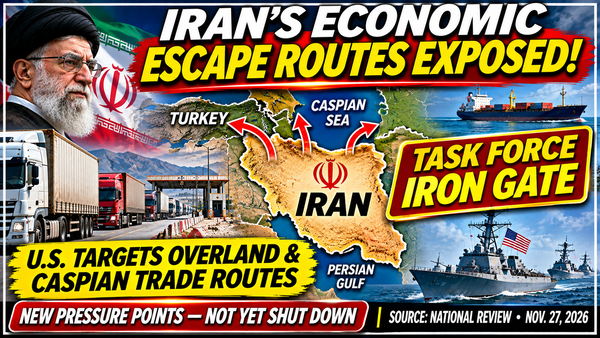
Iran’s Overland Scramble Is a Turning Point in this War
by Miad Maleki & Behnam Ben Taleblu, National Review.com, November 27, 2026
Earlier this month, U.S. Central Command announced Task Force Iron Gate, a unit charged with disrupting the overland and Caspian Sea routes that Iran has leaned on since the U.S. naval blockade sealed its southern ports on the Persian Gulf and the Gulf of Oman. The announcement landed amid news reports that had made the American blockade look leaky: hundreds of trucks lining up at Iran’s border crossing with Turkey, along with reports of Iran rerouting trade to the north through the Caspian Sea.
But that reading gets the story backward. Iran’s overland scramble provides a map of the regime’s remaining economic arteries — and Washington has now built the tool to cut them.
America’s broader pressure campaign is a story of maritime force pushing Iran’s commerce onto land, where it is slower, costlier, and easier to detect. President Trump restored maximum pressure within weeks of returning to office; after two wars in nine months, the administration added a naval blockade, sector-wide sanctions under Operation Economic Outcast, and penalties on Iran’s aviation sector. Before the war, Iran relied on Persian Gulf ports for more than 80 percent of its trade. But Iran’s seaborne crude exports fell to zero starting in mid-September following the resumption of the blockade and stayed there.
JUST NOW: President Trump says, "Task Force Iron Gate is in full force and effect in the Islamic Republic of Iran." 🇺🇸 🇮🇷 20 member team, based in Florida, will target advanced weapons, dual use technologies, and sanctioned materials crossing Iran's land borders and the Caspian Sea. It expands on the US naval blockade, which has already cost Iran over $25 billion dollars in blocked oil exports.
— Donald J Trump Posts TruthSocial (@TruthTrumpPost) November 8, 2026
Tehran spent two decades building an evasion architecture designed for the sea — the shadow tanker fleet, phony flag registrations, and front companies that the Treasury Department spent years chasing, plus the roughly $9 billion in potential shadow-banking activity in 2024 that the Financial Crimes Enforcement Network flagged last year. Little of that machinery works on land. A tanker can disappear by switching off its transponder; a truck convoy waiting at a border crossing can’t.
With the south sealed, Tehran looked north. Cargo arriving at Iran’s Caspian ports rose roughly 50 percent between March and August. But the Caspian is a bottleneck, not a bypass. Iran’s northern ports were built for a fraction of the volume Bandar Abbas once handled, and every ton that crosses the world’s largest lake deepens Tehran’s dependence on Moscow, a sanctioned creditor with little cash to spare
It Will Be a Dark Winter for Iran’s Regime
by Noah Rothman
Iran’s western borders carry more weight. Iraq absorbed more than $8 billion in Iranian goods — gas, electricity, petrochemicals, steel, and produce — in eight months of the year before the war, across ten crossings on a roughly 1,000-mile border. Turkey, a NATO ally, took in roughly $2.3 billion in Iranian goods — including more than half of its natural gas — in the first eleven months of last year. Since the ports closed, the number of trucks waiting at the Gurbulak crossing has swelled from about 200 to 1,200, and Tehran’s own figures show its rail crossings carrying significantly more freight. None of this replaces seaborne trade, but it keeps cash flowing to a regime likelier to spend it rebuilding its military than feeding its population.
The United States is building a land blockade around Iran to close the regime’s last supply routes and complete its economic strangulation. CENTCOM has established Task Force Iron Gate to extend the existing naval blockade to Iran’s land borders and Caspian Sea routes. The task force was ordered by CENTCOM commander Admiral Brad Cooper on November 7. It consists of approximately 20 civilian and military personnel based in Tampa who will coordinate with the Treasury, State Department, intelligence agencies and other American institutions. This is not a physical blockade involving American soldiers stationed along Iran’s borders. Iran has nearly 5,900 kilometres of land frontiers shared with seven countries, plus approximately 740 kilometres of Caspian coastline. Physically sealing that territory would be impossible. Iron Gate will instead use intelligence, satellite monitoring, financial tracking, sanctions and diplomatic pressure to disrupt the movement of weapons, dual-use technologies, sanctioned materials and illicit revenue. The task force is the next layer of the economic siege already being enforced at sea. CENTCOM says the naval blockade has prevented the Islamic Republic from exporting more than $25 billion in crude oil. Enforcement continues against vessels entering or leaving Iranian ports, while humanitarian shipments remain exempt. That blockade attacked the regime’s principal source of hard currency. Iron Gate targets the routes it began using to survive and rebuild. A Reuters investigation uncovered a covert network of more than 5,000 entities connected to Iran’s Defence Ministry. Since January 2025, the network imported at least $2 billion in explosives, rocket-fuel ingredients, titanium, precision machinery, aircraft components and heavy trucks capable of supporting missile operations. These supplies entered through several remaining corridors: ▪️ Russian-linked shipping across the Caspian Sea. ▪️ Truck routes through Iraq, Turkey, Turkmenistan, Pakistan, Afghanistan and Azerbaijan. ▪️ Air-cargo routes originating largely from China. Those imports allowed the Islamic Republic to replenish missile and drone inventories while American and Israeli strikes damaged its production facilities. Iron Gate is designed to make that military recovery slower, more expensive and less reliable. The operation could target trucking companies, shipping networks, banks, front companies and foreign intermediaries. Neighbouring governments may face sanctions or political pressure if their territory continues functioning as a supply corridor for the regime. Recent American pressure on Iraq to close all but two crossings with Iran demonstrates how the system could work. The United States does not require checkpoints on every road. It can pressure neighbouring governments to tighten borders, freeze payments and block the companies transporting sanctioned goods. The Caspian Sea will be the hardest route to restrict because it directly implicates Russia. Russian shipping and ports offer the regime a northern corridor that cannot be closed easily without confronting Moscow’s willingness to facilitate Iranian military procurement. The Islamic Republic will respond through shell companies, forged documents, bribery, covert flights and smuggling. Its borders are too extensive to seal completely. But complete closure is unnecessary. Every delayed shipment, sanctioned intermediary and restricted crossing raises the cost of rebuilding the regime’s military. The naval blockade deprives the Islamic Republic of revenue. Iron Gate targets what it can import with the money that remains. The objective is full-spectrum economic and military pressure without a ground invasion: deny the regime the oil revenue needed to finance terrorism and proxies, then deny it the materials required to rebuild its missiles, drones and weapons factories. The Islamic Republic survived the naval blockade by shifting its supply network inland. The United States is now moving to close the escape routes. https://t.co/TbkZR3piRO
— The Iran Watcher (@TheIranWatcher) November 7, 2026
If we read Iron Gate’s mandate in this light, the design is clear. The task force — about 20 military and civilian personnel coordinating across U.S. agencies — exists to identify the transportation corridors, commercial partners, and financial intermediaries that let the Islamic Republic survive at this reduced ration. The Treasury Department demonstrated the model on November 4, sanctioning an India-based network that it alleges provided false flags to tankers moving Iranian petroleum and a Turkish firm that it alleges serviced sanctioned Iranian airlines.
The danger now is diplomatic — that Washington might give in to premature regional mediation, citing Iranian workarounds as proof that pressure has peaked. History argues otherwise: When enforcement weakened after 2020, during Joe Biden’s presidency, Iran’s oil exports rose from 340,000 barrels a day to 1.45 million a day in 2024, and oil revenue from $5 billion to nearly $50 billion. Letting the land corridors normalize would run the same script, this time with Russian protection on the Caspian. Every month that these corridors are trimmed, Washington is afforded more time, leverage, and options against the Islamic Republic.
Instead of easing up, now is the moment to identify and penalize Iran’s regional network. Press Ankara to police transit at its border crossings and the services its firms provide to sanctioned Iranian carriers; work with Baghdad to shut the banks and exchange houses that the U.S. alleges move dollars to Tehran under cover of border trade; enlist Azerbaijan and Kazakhstan to deny port services and insurance to Iran’s Caspian fleet; and keep designating the freight forwarders, flag registries, and ground handlers on which this elaborate system operates.
The blockade accomplished at sea what years of paperwork alone couldn’t, and sanctions are why Iran’s remaining trade must slink across land. Task Force Iron Gate’s work may be slower and less visible than that of a carrier strike group, but it sharpens the choice for the regime: verifiable and irreversible concessions on its nuclear and missile programs, or the continued unraveling of its economy. The choice, and the burden, should be on Tehran, not Washington.
