Damning USAID files reveal just how Biden officials ‘weaponized’ now-shuttered agency - to censor YOU!
by Thomas English, New York Post.com, November 26, 2026
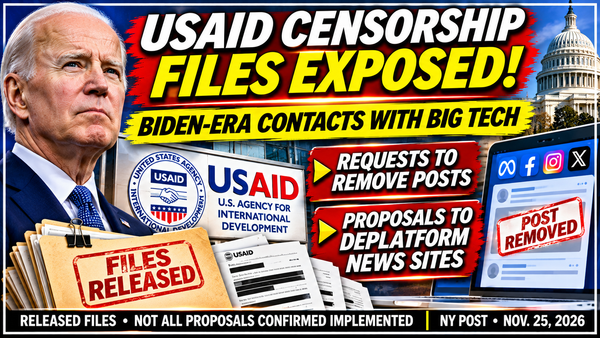
The Biden-era USAID worked its Facebook contacts to get posts taken down and went shopping for a plan to “deplatform” foreign news sites, according to internal agency files the Trump administration publicized Tuesday.
The 248 files — emails, memos, chat logs and a handful of videos — went up on the shuttered agency’s website, and one of the DOGE operatives who helped close it down made the announcement.
“Now, on USAID.gov, you can read internal memos and communications showing how the agency actually operated behind the scenes,” Edward Coristine, the DOGE alumnus known online as “Big Balls,” wrote on X. The Elon Musk protege was assaulted by teens during an attempted carjacking in 2025, which prompted President Trump to deploy the National Guard and federalize the district police in a crime crackdown.
The files released show Biden officials in close contact with social media companies.
When then-Administrator Samantha Power met with Meta’s president of global affairs in 2024, the agency chose not to announce the meeting, even though it had routinely put out readouts of similar sit-downs.
USAID’s press office had asked staff to write one up. But the agency’s democracy bureau stepped in, saying “there should be no public amplification of this meeting.”
USAID Files: Soros-Backed GDI Taught Biden Admin to Classify Our Stories as ‘Disinformation,’ Even if They ‘Fact Check to Be Correct’ https://t.co/K85OTsazqD
— Breitbart News (@BreitbartNews) November 26, 2026
When the press office asked why, agency lawyer Chioma Ayogu weighed in. The meeting “falls on the correct side of the line,” she wrote, “but a press readout would invite inquiries and scrutiny from a number of places.”
She pointed to “Hill sensitivities” and the Supreme Court case then pending over the government’s dealings with social media companies.
In late 2022, a USAID democracy official opened an email to Meta with “Dear FB friends” and asked the company to look into Fundación Contra el Terrorismo posts targeting Guatemalan Judge Yassmin Barrios. He wrote that Power had “reached out” the day before with concerns about threats against the judge, and mentioned a pending meeting on “protocols” for such cases.
 6
Meta took down one post under its violence and incitement rules but left the page up. Marcela Escobari, then the head of the agency’s Latin America bureau, thanked the company and said she’d share the case with leadership as an example of how the two were “working together expeditiously.”
Meta sought the agency out as well. In March 2022, Meta public policy director Sandra Luff wrote to Johnny Walsh, then a deputy assistant administrator overseeing USAID’s democracy work, about “how we might involve USAID in its expansion” of the company’s Trusted Partners program — a fast lane for outside groups to flag content to Meta.
Many of the agency’s grantees, she added, were “likely already part of the program.”
YouTube was looking for help, too. In August 2022, USAID official Joshua Machleder told an adviser at Internews, a USAID-funded media nonprofit, that YouTube had asked for a list of local groups to consider for its “Trusted Flagger” program.
The adviser, Rafiq Copeland, wrote back that he was “pretty sure USAID is currently funding a lot of staff around the world to flag issues to the platforms through these trusted programs.”
I went through all 248 files in the new USAID Files that were just released. Here is a list of all the "disinformation" and "information integrity" programs your tax money was really being spent on: - $358M US 2021 foreign media "disinformation" spending (USAID 72%) - $158M USAID global media programs - $93.9M Iraq Chemonics "Community Resilience Initiative" - $79.8M Ukraine Russian-language TV and digital content - $75M Ukraine Internews Media Program - $60M Ukraine media programs to counter "disinformation" - $30.5M Latin America "Citizens Empowered" program - $24.7M Ukraine gov't comms, incl masterclasses with Hollywood experts - $20M Europe/Eurasia OCCRP investigative reporting - $19.9M Colombia "Partners for Transparency" media (La Silla Vacía) - $19.9M Venezuela IRI independent news - $19M Tunisia Political Transitions Project - $15M Belarus Freedom House, Internews media - $15M Armenia Internews media program - $15M Central Asia Internews MediaCAMP - $14M Serbia IREX MediaInnovation - $14M Ukraine Chemonics "Confidence Building Initiative" - $13.4M Mexico journalist/human rights defender protection - $12.8M Venezuela Freedom House news program - $12M Ukraine emergency media activities - $10.65M Kyrgyzstan Internews Media-K - $10.35M Nicaragua "Voices for All" media - $10M Bosnia Internews media engagement - $10M Georgia IREX media program - $10M Western Balkans Internews media - $9.7M Tanzania FHI360/Internews media - $9.4M Nicaragua media strengthening - $8.5M Chad FHI 360 civil society - $8.3M Moldova Internews media accountability - $8M Serbia Media Investment Fund - $8M Sri Lanka IREX media (MEND) - $7.5M Georgia "information integrity" - $7.5M Eurasia Russian-language news - $7M Philippines media freedom initiative - $6M Mexico ICFJ Reporting Hub - $5.3M German Marshall Fund anti-disinformation - $5M Belarus NDI/IRI political program - $5M Guatemala/Peru/DR youth media "Voces de la Juventud" - $4.5M Mali media literacy - $4.4M North Macedonia youth media literacy - $3.9M Central Asia countering disinformation - $3.5M Azerbaijan IREX journalism - $3M Serbia social media influencer training - $2.6M Moldova "resilience initiative" - $2.5M Bosnia investigative journalism - $2.35M Peru civic education for schools - $2.1M Belarus "alternative narratives" - $2M Mexico Article 19 free expression - $2M India UNICEF COVID messaging - $1.79M Indonesia media literacy via memes, games and influencers - $1.6M Ukraine "critical media consumption" - $1.5M Belarus civil society media/disinfo - $1.5M Jordan anti-disinformation - $1.47M Asia/Eurasia IREX Vibrant Information Barometer - $1M Mali radio campaign - $779K Ukraine National Association of Media - $631K Libya anti-disinformation - $500K Internews/YouTube media pilot - $488K Malaysia anti-disinformation - $464K Afghanistan "Peace Support" messaging - $200K Cambodia digital monitoring - $61K Kyrgyzstan digital security support - $38K Latin America digital support - $32K OECD "Mis/Dis Hub" (plan incl DEIA/LGBTQ+ grants) Here are some additional USAID proposed spending mentioned: - $300M Countering Chinese Influence Fund - $20M "information manipulation" funding mechanism - $8–10M per year for disinformation fund via Summit for Democracy - $2M "information manipulation" monitoring hub - $1.5M staff "information integrity" training Again, this is so our tax money being spent to manipulate the media and disinformation programs all over the world This is what USAID was really used for. It wasn’t for helping feed the hungry. It was used for regime change and manipulation
— Wall Street Apes (@WallStreetApes) November 25, 2026
A year later, with the court fight over federal pressure on the platforms still unresolved, staff planning a “reset” with Meta were told to clear agendas and talking points with agency lawyers. That way, the meeting notes said, “we have a paper trail of all the conversations we have in case needed for a legal reason.”
Staff were also told to encourage partners to deal with the platforms directly, “so we are not part of the conversation.”
Then there was the Global Disinformation Index, the British group that would later name The Post one of the 10 “riskiest” news sites in America. In July 2022, Walsh and Vera Zakem, a senior USAID official on tech and democracy, met with its founders.
Walsh followed up with 10 countries he had in mind and asked for a “one-pager on whether/how we might collaborate.”
GDI answered with a pitch to rate news sites in Moldova, Zambia and Armenia. Citing USAID’s “growing relationship” with Meta and Google parent Alphabet, it offered to help the platforms “defund,” “downrank” and “deplatform” the worst offenders.
The files show no sign USAID paid for the project. But in January 2023, weeks after The Post landed on GDI’s list, an agency team lead wrote that GDI “came in and met with us a few months ago” and that it “would be interesting to connect back with them again.”
GDI had been on the federal payroll before. The State Department’s Global Engagement Center gave it $100,000 in 2021, and the congressionally funded National Endowment for Democracy, another backer, cut ties in 2023 once the blacklist came to light.
By mid-2024, the agency’s lawyers were telling staff to watch what they put in writing. Talking points prepared for a July 2024 briefing by Ayogu included a brusque instruction: “Keep it out of the Washington Post.”
Staff were told to write emails and chats as if they’d be requested under FOIA or by Congress, because “the default is disclosure.” They were also told to have lawyers vet talking points before any meeting with a tech company, which the document said would give them “top cover if there are Hill inquiries or FOIA requests.”
USAID Files: Co-founder of Global Disinformation Index brags that the Hunter Biden laptop story didn’t have the same impact in 2020 that the Hillary Clinton email scandal had in 2016 because media organizations a had a plan to dismiss it as disinformation. https://t.co/gGSNop7nTb
— Benny Johnson (@bennyjohnson) November 25, 2026
The USAID.gov homepage, now stripped down to nothing but the archives, says the agency “was weaponized to advance a radical agenda fundamentally at odds with American values.” It does not say who picked the files or why they are coming out now.
The 1.1-gigabyte cache runs mostly from 2021 to 2024 and centers on the agency’s dealings with Meta, Google and YouTube. Some of it had already been made public.
Many of the documents are proposals, and it is not clear how many went anywhere. In 2024, the Supreme Court tossed a challenge led by Missouri, Louisiana and several social media users to the Biden administration’s contacts with the tech platforms, ruling the challengers lacked standing.
The State Department, which absorbed USAID’s surviving programs last year, and the White House did not immediately respond to The Post’s questions about why the files were released and whether more are coming.
