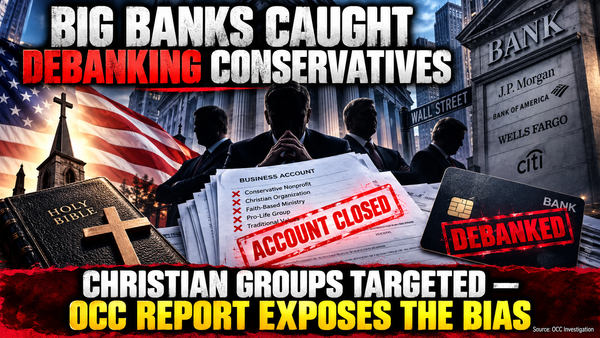
Big Banks Cut Off Conservatives and Christian Groups, OCC Investigation Finds
by John Carney, Breitbart.com, October 15, 2026Major U.S. banks denied financial services to conservative businesses, Trump merchandise sellers and Christian organizations, with employees citing customers’ political views, religious beliefs and conflicts with the banks’ own values, the Office of the Comptroller of the Currency said in a report released Wednesday.
The Office of the Comptroller of the Currency’s report documents account closures, rejected financing and internal screening for terms including “MAGA” and “America First.” It also shows bank employees weighing potential pressure from the Biden administration when deciding whether to serve lawful businesses.
The agency is considering additional rules, bringing debanking records into merger and community-lending reviews, and opening a path for customers to obtain confidential supervisory information in private litigation.
All nine national banks that the OCC reviewed maintained policies restricting services or requiring heightened scrutiny based on reputation risk or industry. The specific findings varied: JPMorgan Chase, PNC, Wells Fargo, and Capital One were cited in completed denials or closures involving political or religious views. The report’s examples involving Citibank and Bank of America concerned industry restrictions and other so-called “reputation-risk” decisions, rather than denials based on customers’ religious beliefs or political affiliations.
Industry restrictions covered Arctic oil and gas exploration and development, coal mining and coal-fired power plants, firearms and ammunition, private prisons and detention facilities, tobacco and e-cigarettes, and digital assets.
By subscribing, you agree to our terms of use & privacy policy. You will receive email marketing messages from Breitbart News Network to the email you provide. You may unsubscribe at any time.
Many restrictions reflected anticipated reactions from activists, shareholders, politicians and other stakeholders rather than assessments of financial or operational risk. Digital-asset restrictions were also frequently attributed to concerns about financial crime.
“Today’s report provides irrefutable evidence that the nation’s largest banks have denied, debanked and discriminated against customers and lawful businesses,” Comptroller Jonathan Gould said in an accompanying statement.
The review examined nearly 100,000 complaints, hundreds of individual decisions and approximately 420,000 pages of bank documents. The review covered 2020 through September 2025. President Donald Trump ordered the investigation as part of his effort to end politically motivated debanking.
The OCC said banking decisions should rest on measurable, impartial, risk-based standards adopted in advance. Instead, banks often relied on subjective judgments about public opinion, diverting attention from financial risks they could assess objectively.
Big banks are groveling to Donald Trump, praying they won't be his next target. After decades of de-banking conservatives, steering the nation’s capital to woke garage, and racial and religious discrimination, now they want forgiveness. https://t.co/T6yGCTr8KE
— Peter St Onge, Ph.D. (@profstonge) July 10, 2025
Several of the banks contacted by Breitbart News declined to comment on the record, referring to a statement issued by the Bank Policy Institute, a financial sector trade group.
“The banking industry supports fair access to banking services and has been working to ensure that government regulations and policies enable banks to serve law-abiding customers,” BPI said. “We support efforts to establish clear and consistent standards that promote access while maintaining sound risk management, including the administration’s recent efforts to prioritize supervisory attention on material financial risk and rather than reputational risk.”
Business Owners’ Views Conflicted With Bank “Values”
PNC declined a credit line to a media company in late 2021 after employees cited its conservative owners’ views and affiliations. The relationship manager had described the company as growing and performing without flagging specific credit risks then under consideration.
Employees cited one owner’s conservative political commentary and another’s funding of Christian conservative organizations, including those designated by the SPLC as hate groups.
“I think it becomes really difficult to justify aligning ourselves with a company whose owners have built very public personas around opinions very contrary to PNC’s beliefs/values,” an employee wrote.
Wells Fargo pressed a payment intermediary to reconsider serving a religious nonprofit after the intermediary initially concluded that it had not violated rules against promoting hate, violence, harassment or abuse.
The bank supplied information about the nonprofit’s views on same-sex marriage. The intermediary then terminated services immediately, disrupting recurring donations and forcing the organization to contact donors and change its website. It later offered reinstatement, which the nonprofit declined.
When asked about identifying problematic merchants, Wells Fargo pointed to the far-left, discredited SPLC, the Anti-Defamation League and BloodMoney.org as resources, while saying it endorsed no specific resource and independent review was necessary. Earlier this year, a grand jury indicted the SPLC on fraud charges alleging the organization told donors and banks that it was fighting racist and extremist groups while it was instead funneling payments to confidential informants in the groups to fund “violent, racist and extremist activities.”
The OCC said reliance on advocacy organizations and other nontraditional sources introduced additional potential subjectivity and bias into reputation-risk assessments.
The Wells Fargo case began when an unnamed card network sent the bank a list of about 60 potentially problematic merchants after what the report describes as a highly publicized, politicized event. The OCC identifies card networks as a catalyst for some bank investigations and twice suggests other agencies may wish to examine their rules or activities.
Capital One’s restrictions reached organizations across the political spectrum. One business line treated partisan activity as presumptively high reputation risk, rejecting abortion-rights organizations, a public education organization whose political arm endorsed Democrats, and a gun rights group.
TD Bank prepared to reject an anti-immigration nonprofit’s second Paycheck Protection Program application, with proposed talking points saying its statements conflicted with TD’s values. Its review also cited an SPLC designation. The nonprofit ultimately withdrew because it was ineligible. TD separately flagged pro-life and faith-based organizations for reputation-risk concerns.
Fear of Biden-Era Supervisory Pressure
The report provides direct evidence that expectations about government policy influenced bank decisions. Reviewing a prospective firearms customer in 2024, Wells Fargo employees wrote: “Under the Biden administration, banks could face greater supervisory pressure to move away from lending to the firearms industry.”
The bank cited similar concerns in another firearms review. Both opportunities were declined, with limited revenue potential also supporting the decisions.
Bank of America wound down relationships with private-prison companies. In one case, employees described a longtime customer as financially sound while discussing political scrutiny and pressure from advocacy groups.
According to the report, a senior public policy leader at Bank of America explained in 2025 that the bank had previously exited a private-prison relationship because of risks associated with “changing policymaker attitudes.” Months into Trump’s return, the bank sought to restore that relationship and approved it despite materially unchanged reputation-risk factors.
Citibank declined financing opportunities involving a coal-dependent electricity provider and refused an IPO transaction involving a firearms business that did not meet its gun-sales standards.
Separately, Citi had publicly announced in June 2025 that it would eliminate its firearms policy and expressly prohibit discrimination based on political affiliation in its employee code and financial-access policy. Breitbart News covered the firearms-policy reversal.
The OCC report also found that BMO required a firearms-related customer to keep tactical-product sales below 30 percent of total sales. Its policy called for transitioning customers out if they refused its firearms standards. U.S. Bank closed an aviation company’s accounts after discovering an old report alleging participation in a controversial government program.
Silicon Valley Cancel Culture at JP Morgan Chase’s WePay
Several of the starkest cases involved WePay, a Silicon Valley-based financial technology firm that JPMorgan Chase acquired in 2017.
In February 2021, WePay closed a Trump merchandise seller’s account after determining its products promoted hate, violence, or racial intolerance, according to the OCC. An employee explained internally that “MAGA and Trump-related items” were among the violations.
WePay’s screening list included “MAGA,” “Make America Great” and “America First.” The report found that neither WePay nor JPMorgan had formal written standards for evaluating potential violations involving the promotion of hate or violence.
Another merchant lost its account after employees flagged products including a Trump victory flag, a shirt calling Biden illegitimate and a “Big Lie” sticker.
WePay also terminated services for an event organizer whose social media posts called Biden and Anthony Fauci “the enemy” and described Black Lives Matter as Marxist. Employees characterized the posts as inciting hate. That closure was subsequently reversed.
A religious nonprofit lost services after employees described it as a “[r]ight wing religious conservative non profit with strong anti LGBTQ rhetoric.” The review cited negative coverage and the Southern Poverty Law Center’s designation of the organization as an extremist hate group.
JPMorgan reputation-risk employees recommended exiting the account. In 2023, an employee removed references to the organization being “right wing” and “religious” from the internal tracking system.
In July 2021, WePay also closed an account raising funds for a legal challenge by a “devout Christian” to certain anti-discrimination laws. WePay escalated the matter to JPMorgan reputation-risk employees before closing the account.
Responding to the report, JPMorgan said WePay’s process “did not meet our expectations.”
“We identified it, corrected it, and the business no longer operates,” a spokesperson told the New York Post. “Our policies prohibit discrimination against customers based on political or religious views.”
The OCC’s findings extended beyond WePay. JPMorgan repeatedly declined commercial services to a conservative retailer between 2021 and 2023. After those decisions, a reputation-risk employee, acting at the direction of a more senior employee, changed internal records to remove descriptions including “right-wing” and references to the retailer’s “extreme clients.” Some changes came years after the original decisions.
JPMorgan also had a policy that prohibited financing for certain small firearms manufacturers, the OCC report said. One had clean background searches, positive online reviews, and no identified negative news. The bank nevertheless rejected it under its restricted-industry framework, according to the OCC. The bank rescinded the policy in 2025.
Regulatory Changes and Private Lawsuits
Federal regulators have already eliminated reputation risk from bank supervision.
The OCC and FDIC issued a final rule in April prohibiting supervisory criticism based on reputation risk and pressure to deny services over protected beliefs or politically disfavored lawful activities. The Federal Reserve announced its removal from examinations in June 2025, as Breitbart News reported.
Treasury Secretary Scott Bessent’s broader supervisory reforms were detailed in Breitbart’s report on the financial-stability overhaul and Business Digest’s examination of reputation-risk regulation.
The OCC is also applying existing supervisory powers. Under guidance issued in September 2025, it considers politicized or unlawful debanking when reviewing relevant licensing applications and evaluating banks under the Community Reinvestment Act.
CLICK HERE TO READ THE REST OF THIS ARTICLE AT BREITBART.COM
