White House Unveils Major Reforms of US Research Policy, Redirecting Billions From Universities to Next-Gen Technologies
The Trump administration's "Golden Age of American Innovation" blueprint aims to transform US research by prioritizing AI, individual scientists, advanced manufacturing, and high-impact breakthroughs over traditional university-led models.
by Bhaswati Guha Majumder, International Business Times, July 22, 2026
The White House has announced plans to shift billions of dollars in federal research funding away from traditional higher education institutions and directly into artificial intelligence (AI) and emerging technologies, completely overhauling the American innovation system.
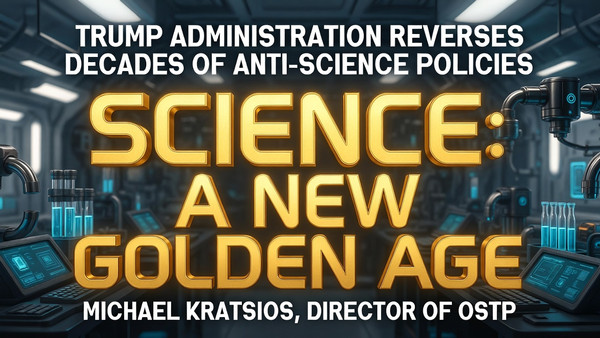
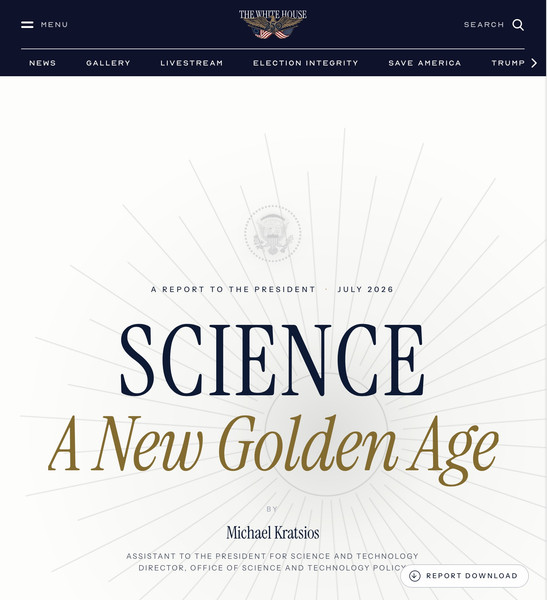
Detailed in a comprehensive report titled "Science: A New Golden Age," authored by Michael Kratsios, Director of the White House Office of Science and Technology Policy (OSTP), the Trump administration presents a radical new blueprint to modernize the nation's scientific infrastructure.
"The American story is one of boundless creativity and bold ambition," President Donald Trump stated, calling for a "Golden Age of American Innovation" to cement US dominance over foreign competitors.
The End of the University Monopoly
For over eight decades, American federal science funding operated on a post-World War II model that prioritized university-based research labs. Now, the new White House report argues this classic model has become hopelessly bogged down.
Researchers now spend nearly half their working hours navigating university bureaucracies and paperwork rather than conducting actual science.
To dismantle these inefficiencies, the White House intends to prioritize individual scientists over legacy institutions.
"The US research system should prioritize the individual scientist over legacy institutions. If we are serious about expanding what our scientists can do, we must invest directly in American researchers and the bold ideas that drive them. Too much of our research enterprise has come to serve itself rather than the scientists within it," the report warns.
By bypassing traditional academic gatekeepers, federal agencies will funnel resources into flexible, fast-track grants, "golden ticket" selection programs, and alternative mission-driven research organizations, redirecting funding away from bloated university overheads toward high-risk, high-reward breakthroughs.
AI Infrastructure Takes Center Stage
At the absolute center of this massive funding realignment is artificial intelligence (AI). The White House plans to reengineer America's national research enterprise specifically for the AI age, noting that AI will radically accelerate the speed of scientific discovery.
A cornerstone of this strategy is the "Genesis Mission", the nation's flagship "AI for science" initiative. The mission aims to fully integrate supercomputers, advanced AI models, scientific instruments, and massive datasets across national laboratories.
The goal is ambitious: to double the overall productivity and impact of U.S. science within a decade.
"As we renew the infrastructure that powers American science, we must reengineer it for the AI age. And even as AI compresses the time from question to answer, we will still need human hands to build the instrument or prototype. We must build that capacity, too, investing in advanced manufacturing, the skilled trades, and the vast pools of talent and tacit knowledge outside the traditional academic pipeline," the report emphasizes.
Rebuilding Industrial Muscle and Skilled Trades
The administration's plan reaches beyond abstract research, explicitly tying scientific discovery back to physical manufacturing and American workers.
Criticizing decades of industrial offshoring, the report notes that discovery without domestic production leaves American taxpayers paying the R&D bill while foreign rivals capture the economic and strategic benefits.
To fix this gap, the White House is demanding a reunification of discovery and manufacturing. The administration plans to fund advanced manufacturing, expand registered apprenticeships and build dense regional innovation hubs across the country.
The policy seeks to integrate hands-on technical training into STEM curricula and create national fellowships for skilled craftspeople and technicians.
Cold War-Style Race for Tech Dominance
The drastic funding shift is driven by urgent national security concerns, particularly as near-peer competitors like China surge resources to challenge U.S. technological supremacy.
"Over the past twenty years, China's R&D spending has surged from a negligible fraction of US levels to full parity on a purchasing-power-adjusted basis by some metrics. This is a situation America did not face even during the Cold War, when the Soviet Union's economy was appreciably smaller than our own," the report said.
This situation has been threatening American leadership in foundational platforms like semiconductors, quantum information science and nuclear technology.
By slashing administrative delays, enforcing strict reproducibility standards, and dismantling regulatory barriers, the Trump administration aims to unleash "permissionless innovation".As the report concludes, this strategic overhaul intends to ensure that the monumental economic and security benefits of modern science accrue directly to the American people first.
