
The High Price of Your Gasoline and Diesel has been ENGINEERED for Decades by the INTENTIONAL Reduction of Refining Capacity to Increase Profits for Big Oil
by Bryan McKee, Via Facebook, September 11, 2026
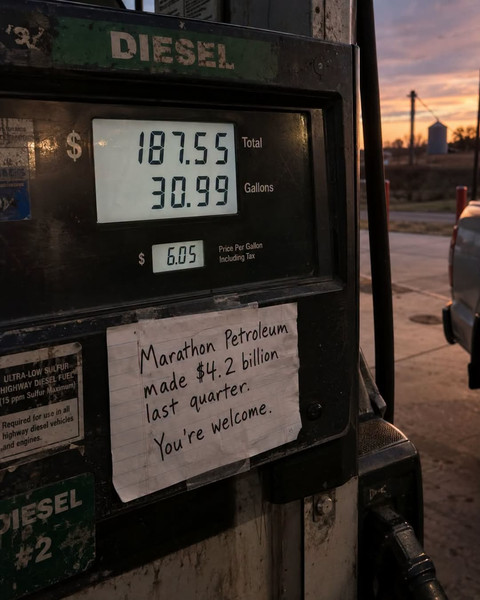
Diesel hit $6.05 per gallon yesterday. The highest price ever recorded in the history of the United States. It set all-time records in 28 states simultaneously. In California, the average is $7.98. Five California stations ran out of room on their price boards and are displaying $9.999, the highest number their machines can physically show.
Americans are spending $700 million more per day on gas and diesel than they did a year ago.
And right on schedule, the argument has started. One side says it is Trump’s fault because of the war with Iran. The other side says it has nothing to do with Trump. Both sides are missing the actual story. And I think that is by design.
The war with Iran is real. The Strait of Hormuz is constrained. Fuel exports are disrupted. That is a factor. But if you stop there you will never understand why $6 diesel is happening now when crude oil is not even close to its all-time high.
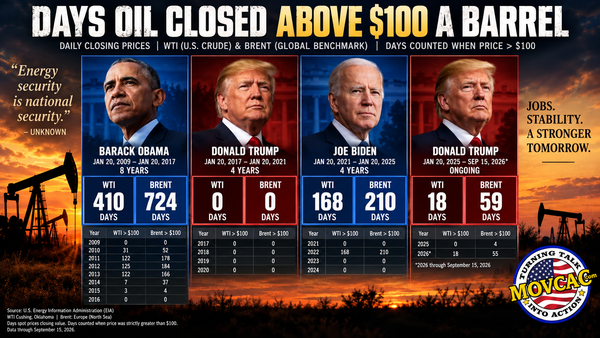
Crude oil hit $100 per barrel this week. That sounds like a lot until you adjust for inflation. In 2008, crude hit $147 per barrel. Adjusted to today’s dollars, that is over $210. In 1980, during the Iranian Revolution, crude hit $36 per barrel. Adjusted to today’s dollars, that is over $160. The current price of crude is well below both of those peaks in real terms.
But diesel was never $6 during those crises. Not in 1980. Not in 2008. Not ever.
The barrel price does not explain $6 diesel. Something else does. And that something else is the part nobody in Washington wants to talk about.
Between 2020 and 2026, 11 major U.S. oil refineries permanently closed or stopped refining crude oil. Not temporarily shut down. Permanently gone. The combined capacity lost is approximately 1.72 million barrels per day gross, roughly 900,000 barrels per day net after accounting for some expansions at remaining facilities.
These were not small operations.
- Philadelphia Energy Solutions in Pennsylvania: 335,000 barrels per day.
- Shell Convent in Louisiana: 211,146 barrels per day.
- Phillips 66 Alliance in Belle Chasse, Louisiana: 255,000 barrels per day.
- Marathon Petroleum in Martinez, California: 161,000 barrels per day.
- LyondellBasell in Houston: 263,776 barrels per day.
- Phillips 66 in Los Angeles: 138,700 barrels per day.
- Valero in Benicia, California: 145,000 barrels per day.
- And several more.
U.S. refining capacity went from a record high of 18.98 million barrels per day at the start of 2020 to approximately 17.9 million by early 2022. The lowest level since 2014. It has continued declining since.
The Energy Information Administration said it plainly. “Typically, we don’t see capacity close and then reopen in the same operating mode, so we think it’s safe to say that the refineries that have closed are probably shuttered for good.”
These companies did not lose these refineries in a fire or a hurricane and never recover. They made a business decision. Demand dropped during COVID. Margins tightened. And instead of weathering the downturn and maintaining capacity for the recovery that everyone knew was coming, they permanently closed facilities, removed the capacity from the market forever, and waited.
When demand came roaring back in 2021 and 2022, the capacity was gone. Fewer refineries processing crude into fuel meant less supply of diesel and gasoline. Less supply meant higher prices. Higher prices meant wider margins. And wider margins meant the largest profits in the history of the refining industry.
The refining margin is called the crack spread. It is the difference between what a refiner pays for a barrel of crude oil and what they earn selling the refined products. From 2010 to 2021, the historical average crack spread was $10 to $16 per barrel. That was normal. That was steady. For over a decade.
In 2022, when the Russia-Ukraine war disrupted European fuel supply while U.S. refining capacity was still depleted from the closures, crack spreads exploded to $50 to $60 per barrel. Three to four times the historical norm.
In 2023 and 2024, spreads came down to $15 to $25. Closer to normal. Prices at the pump came down some. But they never went back to where they were before. The floor had been permanently raised.
Now in 2026, with the Iran war disrupting the Strait of Hormuz and Ukrainian drones hitting Russian refineries, crack spreads have surged past even the 2022 records. And the companies that removed the capacity are harvesting the consequences.
Marathon Petroleum, Valero Energy, and Phillips 66 collectively earned $12.6 billion in the second quarter of 2026 alone. Their highest combined quarterly result since 2022. Their stock prices are surging. Forbes reported in July that refining stocks are soaring as crack spreads hit record highs.
Marathon is the company that permanently closed its Martinez, California and Gallup, New Mexico refineries during COVID.
Phillips 66 is the company that closed its Alliance refinery in Louisiana after Hurricane Ida, closed its Rodeo and Santa Maria facilities in California, and closed its Los Angeles refinery in October 2025.
Valero is the company that ceased operations at its Benicia, California refinery in early 2026.
The same companies that removed the capacity are the same companies posting record profits from the scarcity that removal created.
And here is where it becomes something more than just a market story.
Before COVID, the oil and gas industry spent roughly $55 to $68 million per election cycle on political contributions to federal candidates and parties. That was the steady state for a decade. $56 million in 2018. $63 million in 2020.
In the 2024 election cycle, the oil and gas industry spent $219 million to influence the election. $67 million directly to candidates. $151 million in outside spending through PACs and super PACs. 88% of it went to Republicans.
From $63 million in 2020 to $219 million in 2024. A 247% increase in a single cycle.
Annual lobbying went from $112 million in 2020 to $154 million in 2024. The American Fuel and Petrochemical Manufacturers, the trade group that specifically represents refining companies, doubled its own lobbying budget from a $3.4 million annual average to $6.9 million starting in 2023, the same year its members were posting record profits from constrained supply.
The refiners’ trade group doubled its lobbying the same year the refiners posted their highest profits from the capacity they deliberately destroyed.
Valero tripled its political contributions from the 2022 cycle to the 2024 cycle. $1.78 million to $5.66 million. This is the same company that closed its Benicia refinery in early 2026, removing another 145,000 barrels per day, and posted billions in quarterly profits.
And what are those politicians doing with all that money and all that influence?
They are not investigating why diesel is at $6 when crude does not justify it. They are not holding hearings on refining margins. They are not asking why companies that permanently removed capacity are posting record profits from the scarcity they created. They are not proposing legislation to incentivize new refining capacity or to regulate crack spreads that are running 3 to 5 times their historical average.
They are doing nothing because the money has purchased their silence.
This is the story that neither side of the political argument wants you to see. Blaming Trump and the Iran war is convenient because it puts the problem on one man and one policy decision. Defending Trump by saying the war is necessary and prices will come down is convenient because it avoids examining who is actually profiting and why.
The truth is bigger than either argument.
The war is the accelerant. It is not the cause.
The cause is structural. The refining industry used COVID as cover to permanently reduce capacity. Every crisis that has come since, Russia-Ukraine in 2022, the Iran war in 2026, hits American consumers harder than it should because the cushion was deliberately removed. The system has less margin for disruption. And every disruption generates larger profits for the companies that made the system more fragile by design.
Then those profits get recycled into political spending. $219 million in the 2024 cycle. $154 million in lobbying in a single year. That money buys silence. It buys inaction. It buys the absence of hearings, the absence of investigations, the absence of regulation. And the cycle repeats.
Close the refineries. Tighten the supply. Wait for the next crisis. Harvest the margins. Post record profits. Spend record amounts on politicians. Protect the arrangement. Let the American consumer absorb the cost.
That is not a free market. That is a captured market. And the capture was paid for with profits extracted from the people now paying $6.05 per gallon to drive to work, feed their families, and heat their homes.
Diesel is the lifeblood of the American economy. It powers every truck that delivers every product to every shelf in every store you walk into. It powers the farm equipment that grows your food. It powers the construction equipment that builds your roads and your buildings. It powers the generators that keep your hospitals running when the grid fails. When diesel goes up, everything goes up. Groceries. Shipping. Heating. Construction. Manufacturing. Every cost that touches transportation, and in America that is nearly every cost, has diesel underneath it.
Fuel accounts for 15% to 30% of the total cost of food, according to the Independent Grocers Alliance. When diesel goes from $3.70 to $6.05 in one year, that is not a minor fluctuation. That is a structural shock to the cost of living for every American family.
And the people who engineered the conditions that make that shock possible are posting $12.6 billion in quarterly profits and spending $219 million to make sure the politicians you elected never ask them a single question about it.
The next time someone tells you diesel is expensive because of Trump, ask them why crude is below its inflation-adjusted highs from 2008 and 1980 but diesel is higher than it has ever been in history. Ask them what happened to the 11 refineries that closed since 2020. Ask them what a crack spread is and why it is running 3 to 5 times its historical average. Ask them how much Marathon, Valero, and Phillips 66 made last quarter. Ask them how much the oil and gas industry spent on the 2024 election.
And the next time someone tells you prices will come down when the war ends, ask them why prices never came back down after the Russia-Ukraine disruption faded in 2023. Ask them why the refining capacity that was removed during COVID was never rebuilt. Ask them why every subsequent crisis hits harder than it should.
The answer to both questions is the same.
The system is working exactly as designed. It is just not designed for you.
It is designed for the companies that post record profits every time a crisis creates scarcity. And for the politicians who take their money and look the other way while you pay for it at the pump, at the grocery store, and at your front door every time a package arrives.
$6.05 per gallon.
$12.6 billion in quarterly profits.
$219 million in political spending.
That is not an accident. That is an arrangement.
And you are paying for all of it.
SOURCES / RECEIPTS
Diesel hit $6.05 per gallon, an all-time record; 28 states set records simultaneously:
AAA national average, September 11, 2026
GasBuddy live data confirmed $6.00 crossed on September 10, 2026
CNBC: “U.S. diesel price tops $6 per gallon, a record high as Ukraine and Iran wars ripple through economy” — cnbc.com/2026/09/11
NBC News: “Diesel hits all-time high of $6 per gallon” — nbcnews.com/business/energy
Bloomberg: “US Diesel Prices Rise Past $6 a Gallon for First Time Ever” — September 11, 2026
Patrick De Haan, GasBuddy Head of Petroleum Analysis, confirmed 28 states at all time highs via X post, September 10, 2026
California at $7.98, five stations at $9.999:
CNBC same article, citing AAA data: California at $7.9827
GasBuddy/Patrick De Haan confirmed 5 California stations at $9.999, the maximum their dispensers can display
$700 million more per day on gas and diesel:
GasBuddy analysis cited in CNBC and NBC News coverage, September 11, 2026
Crude oil at $100 per barrel, below inflation-adjusted highs:
PriceOfOil.com: “Oil Price History: From $3 in 1970 to Today” — 2026 Hormuz crisis peak at $111/barrel
InflationData.com: “Oil Price History Chart (Inflation-Adjusted)” — 1980 peak of $36 equals ~$160 in 2026 dollars, 2008 peak of $147 equals ~$210 in 2026 dollars
U.S. Energy Information Administration (EIA) crude oil data: eia.gov/dnav/pet
11 refinery closures since 2020, ~1.72 million barrels per day lost:
Eco3min.fr: “US refinery closures since 2020 — the complete record” — full facility-by-facility registry with capacity, dates, and EIA sources, July 2026
EIA Refinery Capacity Report, 2021: eia.gov/todayinenergy/detail.php?id=48636
Houston Chronicle: “Refinery closures decreased U.S. refinery capacity during 2020” — July 8, 2021
Hydrocarbonprocessing.com: same EIA data, July 2021
Powder & Bulk Solids: “Oil Refinery Closures in an Era of Transition” — November 2023
Specific refinery closures named:
Philadelphia Energy Solutions (335,000 b/d): EIA Refinery Capacity Report 2021
Shell Convent, LA (211,146 b/d): EIA, Houston Chronicle
Phillips 66 Alliance, LA (255,000 b/d): Powder & Bulk Solids, November 2023
Marathon Martinez, CA (161,000 b/d): Marathon Petroleum public announcement, August 2020
Marathon Gallup, NM (27,000 b/d): same announcement
HollyFrontier Cheyenne, WY (48,000 b/d): EIA
Dakota Prairie, Dickinson, ND (19,000 b/d): EIA
Phillips 66 Rodeo + Santa Maria, CA (120,000 b/d): Eco3min.frregistry
LyondellBasell Houston, TX (263,776 b/d): shut down March 2025, Eco3min.fr
Phillips 66 Los Angeles (138,700 b/d): closed October 2025, Eco3min.fr
Valero Benicia, CA (145,000 b/d): ceased operations early 2026, Eco3min.fr
Capacity fell from 18.98 million to ~17.9 million, lowest since 2014:
EIA Refinery Capacity Report: capacity at 18.98 million b/d start of 2020, fell to 18.1 million start of 2021, further to 17.94 million start of 2022
S&P Global reporting on EIA data, June 2022
EIA quote “refineries that have closed are probably shuttered for good”:
Chris Higginbotham, EIA spokesperson, quoted in Breakbulk: http://breakbulk.com/…/us-refinery-closures-impact…
Crack spread historical average $10 to $16, exploded to $50 to $60 in 2022:
AEGIS Hedging: “U.S. Refining Margins Hit an All-Time High” — 2022
GlobalOilShock.com: “Crack Spread Explained” — normal level 2010 to 2021 averaged $10 to $16/barrel, 2022 crisis reached $50 to $60/barrel
Energy IB Guide: “Crack Spreads and Refining Margins” — 2015 to 2021 average approximately $12 to $18/barrel, 2022 spike to $40 to $60/barrel
Nasdaq: “2 Oil Refiners Posting Record Margins” — benchmark crack spread at $35 vs historical average of $10.50
2026 crack spreads surpassed 2022 records:
Forbes: “Refining Stocks Soar As Crack Spread Hits Record High In 2026” — July 23, 2026
Inspenet: “U.S. Refining Margins Drive Record Profits” — August 2026
Marathon, Valero, Phillips 66 earned $12.6 billion Q2 2026:
Inspenet: “U.S. Refining Margins Drive Record Profits” — “Marathon Petroleum, Valero Energy, and Phillips 66 collectively earned US$12.6 billion in profits during the second quarter of 2026, their highest combined result since 2022”
Oil and gas political contributions by cycle:
OpenSecrets: opensecrets.org/industries/totals?ind=E01
2018 cycle: $56 million
2020 cycle: $63 million
2022 cycle: $79+ million
2024 cycle: $219 million total ($67 million to candidates, $151 million outside spending)
$219 million total 2024 cycle, 88% to Republicans:
Yale Climate Connections: “The fossil fuel industry spent $219 million to elect the new U.S. government” — January 3, 2025, citing OpenSecrets data
Lobbying totals:
OpenSecrets: opensecrets.org/industries/lobbying?cycle=2024&ind=E01
2020: $112 million
2024: $154 million
OpenSecrets News: “Oil and gas lobbying reaches $72 million in first half of 2024” — August 2024
American Fuel and Petrochemical Manufacturers doubled lobbying:
OpenSecrets News same article: AFPM averaged $3.4 million annually 2016 to 2022, jumped to $6.9 million in 2023, already exceeded prior years by mid-2024
Marathon Petroleum contributions:
OpenSecrets: http://opensecrets.org/orgs/marathon-petroleum/summary…
2024 cycle: $1,826,002 contributions, $2,520,000 lobbying
Valero Energy contributions:
OpenSecrets: http://opensecrets.org/orgs/valero-energy/summary…
2024 cycle: $5,656,177 contributions, $2,080,000 lobbying
2022 cycle PAC raised: $1,778,900
Phillips 66 contributions:
OpenSecrets: http://opensecrets.org/…/phillip…/C00513549/summary/2022
2022 cycle PAC raised: $1,148,797
Diesel powers the economy, 15% to 30% of food costs:
Independent Grocers Alliance, cited in NPR/WOSU and CNBC September 11, 2026 coverage
KPMG chief economist Diane Swonk: “The cost of diesel gets into just about everything” — cited in NBC News
Crude oil cost represents 50% to 60% of pump price:
EIA: “Factors Affecting Diesel Prices”
Britannica Money: “From Crude Oil to Gasoline” — September 2026
TrueDrivingCost.com: “Diesel Prices Over Time” — citing EIA data
Diesel premium over gasoline widened from $0.26 in the 1990s to $1.11 in 2024:
TrueDrivingCost.com: “Diesel Prices Over Time” — EIA retail price series 1995 to 2024
Every claim. Every number. Every source. All public record.
