Help Us Find Billboard Locations in YOUR AREA!

Times/Siena Poll Finds Socialism Viewed Negatively by Majority of Likely Voters
by Your News.com, September 16, 2026
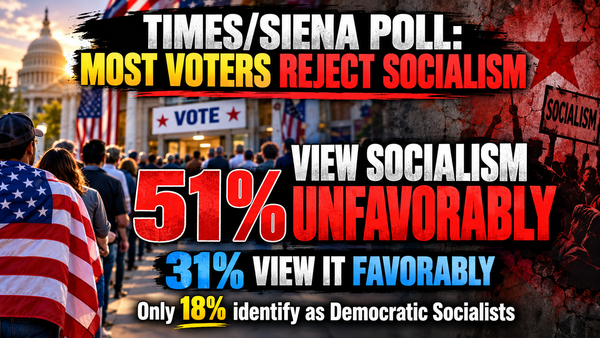
A national Times/Siena survey found 51% of likely voters held an unfavorable view of socialism, while fewer than one in five identified themselves as democratic socialists.
A majority of likely U.S. voters view socialism unfavorably even as candidates identifying with democratic socialism have won several Democratic primaries this year, according to a national poll released Tuesday.
The New York Times/Siena University poll found:
- 51% of likely voters had an unfavorable opinion of socialism.
- 40% said they had not heard of it
- 10% either did not know or declined to answer
The survey did not provide respondents with definitions of either “socialism” or “democratic socialism,” leaving participants to answer according to their own understanding of the terms.
The results showed an additional distinction between holding a favorable opinion of socialism and personally adopting the democratic socialist label.
Eighteen percent of likely voters said they considered themselves democratic socialists, while 80% said they did not.
Identification varied considerably by political affiliation. Among self-identified Democrats, 38% said they considered themselves democratic socialists and 57% said they did not. Among independents, 14% identified with the label.
Age produced another substantial difference.
Among likely voters ages 18 to 29, 33% said they considered themselves democratic socialists. That share declined to 22% among voters ages 30 to 44, 14% among those ages 45 to 64 and 15% among voters 65 and older.
The poll also asked whether a Democratic candidate’s identification as a democratic socialist would affect voters’ preferences.
Thirty percent of likely voters said they would rather support a Democrat who did not consider himself or herself a democratic socialist. Thirteen percent said they would prefer a Democratic candidate who did identify that way.
For 44%, the distinction made no difference, while 9% said they would never vote for a Democrat.
The results shifted among voters who already said they intended to vote for a Democrat for Congress this fall.
Within that group, 23% said they would prefer a democratic socialist candidate, while 17% preferred a Democratic candidate who did not use the label. Fifty-six percent said it would not matter either way.
The polling comes after democratic socialist candidates recorded several victories in Democratic congressional primaries during the summer.
Claire Valdez and Darializa Avila Chevalier won Democratic House primaries in New York after receiving support from the Democratic Socialists of America, while Melat Kiros defeated longtime Rep. Diana DeGette in Colorado’s Democratic primary. Democratic Socialists of America materials identify all three among the organization’s 2026 congressional successes, and Associated Press reporting documented their primary victories.
Those races followed the election of New York City Mayor Zohran Mamdani, who has openly identified with democratic socialism and took office in January.
During his Jan. 1 inaugural address, Mamdani explicitly tied his governing philosophy to that political identity.
“I was elected as a democratic socialist, and I will govern as a democratic socialist,” Mamdani said.
The Times/Siena survey separately measured national opinions of Mamdani and Rep. Alexandria Ocasio-Cortez, D-N.Y., another prominent elected official associated with democratic socialism.
Mamdani was viewed favorably by 38% of likely voters and unfavorably by 33%.
Ocasio-Cortez was viewed favorably by 30% and unfavorably by 41%.
Approximately three in 10 respondents either had not heard enough about each politician to form an opinion or did not provide one.
The findings indicate that opinions about individual politicians associated with democratic socialism do not necessarily track directly with opinions about socialism as an ideological label.
While 51% of likely voters expressed an unfavorable view of socialism overall, Mamdani’s unfavorable rating was 33%. Ocasio-Cortez’s unfavorable rating was 41%. The survey asked about the politicians separately from its questions concerning socialism and democratic socialist identification.
The results also provide context for Republican campaign efforts to emphasize socialism during the 2026 midterm cycle.
Among voters who said they wanted Republicans to control Congress, however, only 5% identified fear of socialism or communism as the primary reason for that preference.
Thirty percent pointed instead to policies or political views, while 29% cited opposition to Democrats. Another 18% identified values or competence as their principal reason.
That finding suggests the socialism issue was not the dominant motivation among respondents favoring Republican control of Congress, despite its presence in campaign messaging.
The Times/Siena findings were released during a year in which democratic socialist candidates have demonstrated strength particularly in Democratic primary contests centered in major cities and heavily Democratic congressional districts. AP reporting confirmed victories by Valdez and Avila Chevalier in New York and Kiros in the Denver-based Colorado district.
The national polling, however, shows that those electoral successes coexist with broader skepticism toward the socialism label among likely voters.
The distinction was particularly visible in the candidate question: although 51% viewed socialism unfavorably, 44% said whether a Democratic candidate called himself or herself a democratic socialist would not affect their vote.
Another 30% said they specifically preferred a Democrat who did not identify as a democratic socialist, compared with 13% who preferred one who did.
The survey also found a significant generational divide in personal identification with democratic socialism, with voters under 30 more than twice as likely to adopt the label as voters between 45 and 64.
That age difference accompanies broader partisan divisions over the ideology and helps explain why democratic socialist candidates have found varying levels of support among different portions of the electorate.
The New York Times and Siena University surveyed 1,503 likely voters from Sept. 8 through Sept. 13. The poll reported a margin of error of plus or minus 2.9 percentage points for the likely-voter sample.
