What to Know About the New ‘Upside Down’ Food Pyramid
The latest federal dietary guidelines reverse some long-standing recommendations in the interest of making Americans healthier.
by Lawrence Wilson, The Epoch Times.com, January 9, 2026
The Department of Agriculture has turned the familiar food pyramid upside down, significantly revising the dietary guidelines used by schools, federal nutrition programs, and millions of Americans.
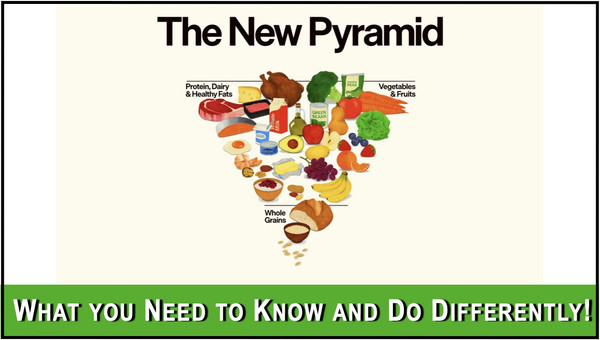
In fact, the old food pyramid had been phased out in the early 2000s in favor of a dinner plate illustration. But the triangular illustration of a balanced diet, with carbohydrate-heavy breads and grains at the base, tapering to meats, dairy products, and saturated fats at the top, lingered in the public consciousness.
The new illustration, released on Jan. 7, more or less inverts the structure.
“These new guidelines are informed by the best and most reliable research on health and nutrition, particularly as it relates to the role of our diets in the prevalence of chronic disease in the country,” Health and Human Services Secretary Robert F. Kennedy Jr. said while presenting the new dietary guidelines alongside Agriculture Secretary Brooke Rollins.
U.S. Department of Health and Human Services Secretary Robert F. Kennedy, Jr. and U.S. Department of Agriculture Secretary Brooke Rollins today released the Dietary Guidelines for Americans, 2025–2030, marking the most significant reset of federal nutrition policy in decades. The new Guidelines deliver a clear, common-sense message to the American people: eat real food.
The U.S. faces a national health emergency. Nearly 90% of health care spending goes toward treating chronic disease, much of it linked to diet and lifestyle. More than 70% of American adults are overweight or obese, and nearly 1 in 3 adolescents has prediabetes. Diet-driven chronic disease now disqualifies many young Americans from military service, threatening national readiness and limiting opportunity.
“These Guidelines return us to the basics,” Secretary Kennedy said. “American households must prioritize whole, nutrient-dense foods—protein, dairy, vegetables, fruits, healthy fats, and whole grains—and dramatically reduce highly processed foods. This is how we Make America Healthy Again.”
The Departments of Agriculture and Health and Human Services revise the guidelines every five years. Here’s a summary of the new guidelines that will be in effect through 2030.Same Foods, New Balance
The guidelines encourage eating many of the same foods—such as nutrient-dense vegetables, fresh fruits, protein-rich meats, nuts and legumes, and whole grains. The difference is in the balance.The familiar version of the old pyramid, dating to 1992, was criticized by experts for placing too much emphasis on carbohydrates and not enough on protein and healthy fats.
More recent versions of the illustration, which featured a dinner plate rather than a pyramid, continued to recommend that carbohydrates fill half of the plate.
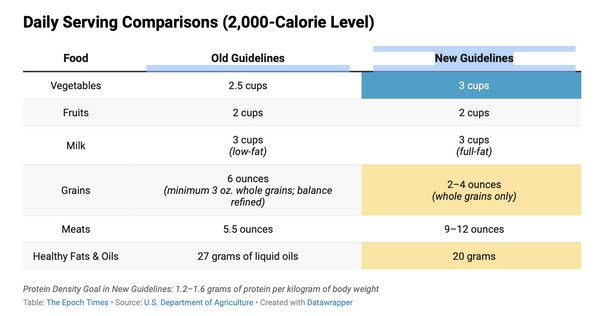
The new illustration and accompanying guidelines place greater emphasis on consuming protein and healthy fats, while deemphasizing carbohydrates, especially processed foods.
“These guidelines replace corporate-driven assumptions with common sense goals and gold-standard scientific integrity,” Rollins said, predicting that they will revolutionize the nation’s food culture.
The new guide is also slimmer, just 10 pages rather than 160, focusing more on behavioral choices than on underlying principles.From ‘Limit’ to ‘Avoid’
The new guidelines take a noticeably stronger stand against foods that are overconsumed, especially sugar.Previous versions of the guide clearly included advice to limit the intake of foods with added sugar. But advice to avoid the use of added sugar was given only to those caring for infants and children.
The new guidelines are more direct: “Avoid sugar-sweetened beverages, such as sodas, fruit drinks, and energy drinks.”
And although some allowance is made for using sugar at mealtimes, it comes with a warning.
“While no amount of added sugars or non-nutritive sweeteners is recommended or considered part of a healthy or nutritious diet, one meal should contain no more than 10 grams of added sugars,” the guidelines state. A teaspoon of sugar is about 4 grams. A 12-ounce can of Coca-Cola contains 39 grams of sugar, according to the manufacturer.
Focus on Protein
The new guidelines are protein-forward.“The new framework centers on protein and healthy fats, vegetables, fruits, and whole grains,” Kennedy said, noting that proteins now appear at the wider end of the pyramid.
Dr. Marty Makary, commissioner of the Food and Drug Administration, said: “The old guidelines had such a low protein recommendation that we are increasing that by 50 percent to 100 percent. Kids need protein. The old protein guidelines were to prevent starvation and withering away. These new protein guidelines are designed for American kids to thrive, and they’re based on science, not on dogma.” Watch the Powerful Video Below:
🚨 NEW RULES: PROTEIN COMES FIRST
— Beef Initiative🇺🇸🇸🇻BeefMaps.com (@beefinitiative) January 8, 2026
“Kids are literally nitrogen negative,” said @DrMakaryFDA.
“We’re increasing protein guidelines by 50–100%.“
“This isn’t a willpower issue—it’s what adults did to kids.”
AMERICA IS HEALING.
🇺🇸 SAVE BEEF pic.twitter.com/r49pOstpbe
Makary said the rise in insulin resistance and whole-body inflammation afflicting children today stems from a “protein-poor, micro-nutrient poor, ultra-processed, refined carbohydrate diet.”
“We are going to finally address the root causes of our broken health care system,” he said.Saturated Fats Are OK
Previous guidelines pictured saturated fat as a source of concern, associating it with processed foods such as burgers, tacos, desserts, high-fat meat, whole milk, and butter.Although the new guide maintains the same recommended intake of saturated fats (10 percent of total calorie intake), it gives favorable mention to full-fat yogurt, whole milk, and cheese.
“You don’t need to tiptoe around fat and dairy. You don’t need to push low-fat milk to kids,” Makary said, adding that the focus is on getting more protein into the diet.
Healthy fats, including cheese, milk, and olive oil, appear near the wider end of the new food pyramid.
“Protein and healthy fats are essential and were wrongly discouraged in prior dietary guidelines,” Kennedy said. “We are ending the war on saturated fats.”Taking On Corporate Interests
One change not stated in the new guidelines was mentioned by Kennedy when he was explaining the shifts in focus: the more direct stance against added sugar and processed foods.“Federal policy promoted and subsidized highly processed foods and refined carbohydrates and turned a blind eye to the disastrous consequences today,” Kennedy said, asserting that this was done to “protect corporate profit taking.”
“The new guidelines recognize that whole, nutrient-dense food is the most effective path to better health and lower health care costs.”
Some critics, however, read the new guidelines as a gift to other industrial interests.
“If federal nutrition guidance is going to promote higher consumption of animal-sourced foods, it has a responsibility to state clearly that those foods must be produced under organic and chemical-free standards,” Elizabeth Kucinich, an organic food advocate, said.
Kucinich cited the use of antibiotics and hormones and exposure to chemicals as concerns in the meat production industry.
