CLICK THE ARROW ABOVE TO WATCH THE PODCAST!
AI Kills Everybody or Doomer Psyop?
This Video Will give You INSIGHT into What the Sudden Release of a Claim that "AI Will Kill US ALL" last week means to YOU! Who did it? Why did they Do it? Who spent the money to make it go super viral? Is the claim True? What is REALLY the Goal?
Then Watch Nvidia Founder Jensen Huang Explain to You WHY AI will not kill us ALL and HOW it can be made Safe!

Follow the Power: What David Sacks Got Right About the Anthropic Resignation
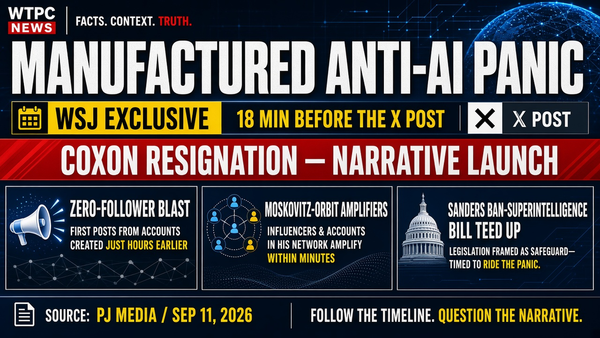
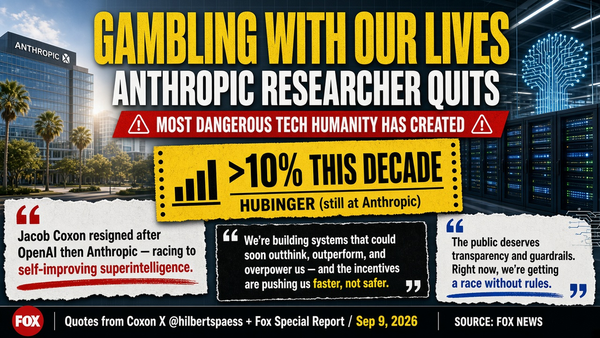
By ALEXANDER MUSE,On Tuesday evening, September 8, at 8:04 PM Eastern, an account on 𝕏 with almost no history posted a thread. Its author, Jacob Coxon, said he had resigned from Anthropic and that both his former employer and OpenAI were gambling with human lives in a race toward self-improving superintelligence. Within 24 hours, the thread had been viewed more than 123 million times. A US senator cited it within 15 hours, a governor within 16, and Elon Musk said he couldn't recall such a reception for a post from a new account with almost no prior activity.
I resigned from Anthropic today. I spent the last three years doing pretraining research at both OpenAI and Anthropic. Neither company is acting responsibly. They are racing straight to self-improving superintelligence and gambling with our lives. More thoughts below.
— Jacob Coxon (@hilbertspaess) September 9, 2026
The Wall Street Journal had already published its exclusive. The paper posted at 7:46 PM, roughly 18 minutes before Coxon told the world. A newspaper does not learn of a resignation before the resigner announces it unless someone arranged the briefing. The story was written in advance and timed to land with the thread. The Journal accidentally published a few minutes early.
David Sacks, the White House AI adviser, laid out that sequence on the All-In podcast, and his critics treated the observation as conspiracy-mongering. The public record does not need a hidden plot. It needs a look at who moved first, who paid the movers, and what those same people have already said they want the government to do.
Sacks asked the question the coverage skipped. What did Coxon actually bring forward? When WIRED asked whether Anthropic was cutting corners, Coxon said, “No, not yet.” He produced no buried memo, no dataset, no incident the company had hidden. His complaint was a forecast about what competition might someday pressure a lab to do. Forecasts can be honest and still be opinions. The press treated the forecast as a disclosure, and that treatment did the work a leaked file would have done.
The first three quote-posts arrived, according to the investigator Parker Thayer, within 15 minutes, two of them within 10. They came from Nathan Calvin, general counsel of Encode AI, which helped shape California’s AI legislation; from Peter Wildeford of the AI Policy Network; and from Daniel Kokotajlo, who leads the AI Futures Project and who happened to have a Joe Rogan appearance circulating at the same moment, using much the same language about AI killing everyone. The 14th quote-poster, about 27 minutes in, worked on AI safety at Coefficient Giving. Perhaps three professional advocates each independently happened to be watching a dormant account at 8 PM on a Tuesday. Sacks’s narrower claim is easier to test. The message reached the public through an existing advocacy network, not through strangers’ organic curiosity.
The grants make the claim institutional rather than personal. The Survival and Flourishing Fund, the philanthropic vehicle associated with Jaan Tallinn, lists 2025 recommendations of $516,000 for Encode AI, $1.635 million for the AI Policy Institute, and more than $2 million across two entries for the AI Futures Project, plus $505,000 for AI Futures in 2024. AI Futures itself names the fund as a principal source of its money. Tallinn is not merely a patron of AI-doom advocacy. He led Anthropic’s $124 million Series A in May 2021, with Dustin Moskovitz among the participants. The same man sits on both sides of the story, as an early owner of the company whose researcher resigned and as the funder of the organizations that amplified the resignation within minutes.
No document shows Tallinn directing a post. But the organizations presented to the public as independent safety voices grew from the same financial soil as the company they claim to be warning about. When those organizations demand rules governing who may build frontier AI, a citizen should ask about their independence before asking about their model of the future.
At 9:27 PM, 83 minutes after the thread, Evan Hubinger, who leads alignment science at Anthropic and still works there, endorsed the warning and assigned a greater-than-10 % probability of human extinction within the decade. When a serving executive attaches a number to a departed colleague’s warning, the opinion starts to look like a company estimate. Anthropic has not disavowed him. Chamath Palihapitiya’s explanation is probably correct. Management cannot disavow him because a substantial faction inside the company believes the same thing. It is fair to ask what a company that believes this intends to do about it, and what it intends to tell the investors it hopes to court in a public offering.
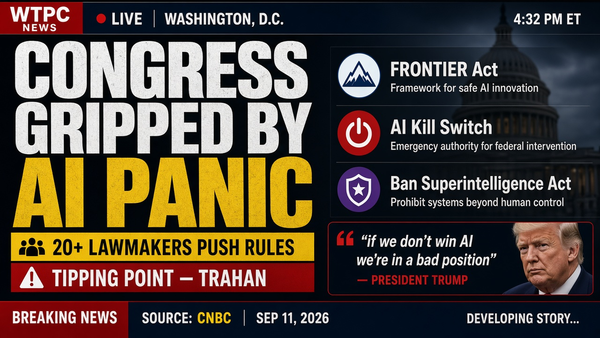
Five days before Coxon resigned, Senator Bernie Sanders and Representative Greg Casar announced legislation to ban artificial superintelligence and pause advanced AI development pending federal rules. The remedy was already written. What it lacked was a witness. On the morning of September 9, Sanders supplied one, citing Coxon to justify his bill, and Governor JB Pritzker followed 42 minutes later. Sacks was explicit that he does not think Sanders planned any of this, and he is right not to claim it. A legislator with a bill in hand needs no invitation to seize a viral warning. The statute did not spring from the thread. It was sitting on the desk when the thread arrived.
The organizations have not been shy about the prize. They want a federal AI regulator. Some want a pause or an outright ban on superintelligence. Four days after the resignation, Dario Amodei, Anthropic’s chief executive, published a proposal calling for embedded outside evaluators inside the labs, coordination among frontier companies in democratic countries, international coordination, and regulation to bind any developer unwilling to join voluntarily. He even discusses a government waiver for the antitrust problems that arise when competitors sit down to set a common pace. That is the CEO describing the ask in his own essay. The leading companies would like permission to coordinate, and they would like the government to compel the companies that will not.
A firm that has already crossed into a valuable market has every reason to praise a drawbridge, even one that costs it a toll. Scholars at the Heritage Foundation have argued that a licensing model for frontier AI would follow the same public-choice logic that already governs occupational boards, where the first firms through the gate help write the rules that follow. Researchers at the Mercatus Center have shown how those rules function as a privilege for incumbents, raising their wages, shrinking the field of rivals, and leaving later entrants, including startups and university labs, to climb a compliance wall the incumbent can already afford. The conservative case and Sacks’s case meet on that point without anyone needing to invent a plot. A compliance shop staffed by hundreds of lawyers is a moat when your competitor is a garage project.
CLICK HERE TO READ THE RESET OF THIS POST AND SUBCRIBE TO ALEXANDER MUSE'S SUBSTACK!
Watch it and Share it! Use the Share Links on this page to send the link to this video to Family and Friends via email and/or text or to post it on social media!